.svg)


What’s More American than a Subdivision?
Subdivisions are one of the most fundamental strategies in residential land development. They have shaped the way American neighborhoods are built for over a century, and they remain one of the primary vehicles through which raw land becomes housing. That said, subdivisions are routinely misunderstood, underestimated, or approached without the analytical rigor they require.
This guide covers what a subdivision is, the different forms it takes, when it creates value and when it does not, and what separates the developers who execute them well from those who find out too late that the numbers never worked.

What Is a Subdivision?
A subdivision is the legal division of a single parcel of land into two or more separately owned lots. Each new lot receives its own legal description, property record, and tax identification. Once subdivided, individual parcels can be sold, mortgaged, or developed independently of one another.
The process is regulated at the local level. A developer seeking to subdivide must submit a subdivision plat: a scaled, recorded document that establishes the new lot boundaries, street rights-of-way, utility easements, and any dedications to the public. Most jurisdictions require plat approval from a planning commission or similar body before any lots can be sold or built upon. Requirements vary significantly by state and municipality, so understanding the local approval process is an essential early step in any subdivision project.
Subdivision vs. Lot Split
It is worth distinguishing a subdivision from a simple lot split. A lot split typically divides one parcel into two and is often handled administratively without full plat review. A subdivision generally involves three or more lots, triggers more extensive review, and carries requirements for road improvements, utility infrastructure, and public dedications that a lot split does not.
Types of Subdivisions
Not all subdivisions are alike. The typology a developer chooses shapes everything from infrastructure cost and approval complexity to product mix and long-term market positioning.
Standard Residential Subdivision
The most common form. Raw land is divided into individual single-family lots, each sold separately or built by the developer. The street layout, lot dimensions, and setback requirements are governed by local zoning. The developer is responsible for installing roads, utilities, and drainage before lots can be sold or homes constructed. Local planning commissions review and approve the subdivision plat against jurisdiction-specific standards for lot size, frontage, and public infrastructure before any conveyance can occur.
Planned Unit Development (PUD) and Master-Planned Community
PUDs and master-planned communities sit at the more complex end of the subdivision spectrum, and the National Association of Realtors treats them as closely related typologies. A PUD is evaluated as a unified development plan rather than lot-by-lot, which allows for mixed housing types, shared open space, and design flexibility that conventional subdivision zoning would not permit. Approving a PUD typically requires a rezoning process in which the planning board reviews the full site plan against the municipality’s comprehensive plan. A master-planned community extends that logic to a much larger scale, layering residential, commercial, and civic uses across hundreds or thousands of acres developed in phases over years or decades. According to NAR, master-planned communities typically cover at least 2,500 acres and can extend to over 10,000 acres, with anywhere from 100 to 50,000 homes. Each phase requires its own plat approval and infrastructure build-out, making early yield modeling and phasing strategy especially valuable.
Conservation Subdivision
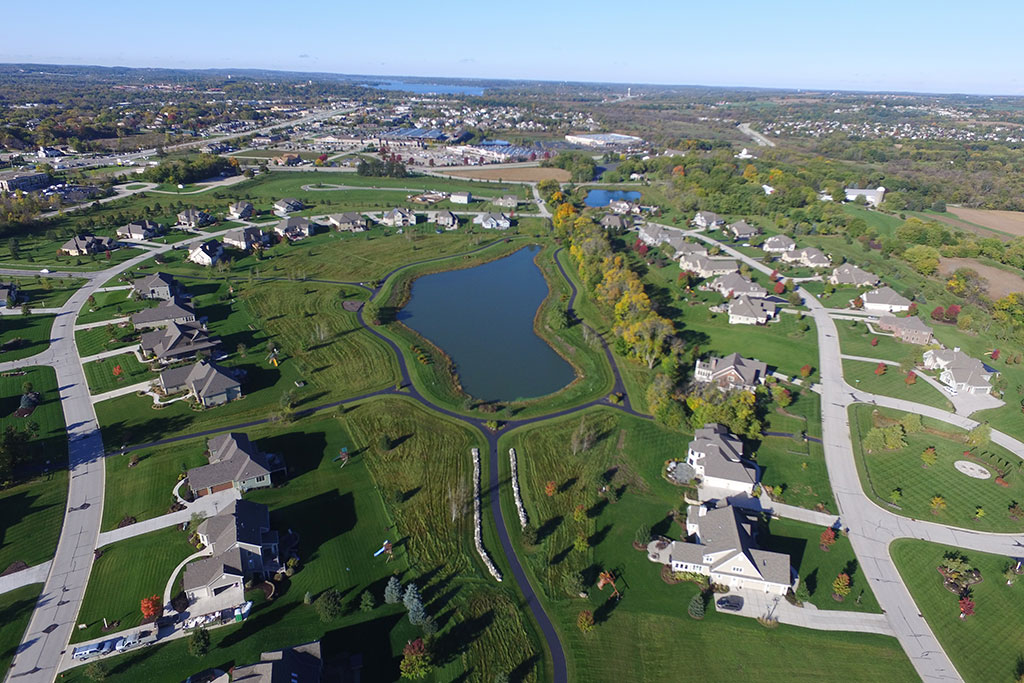
Conservation subdivisions cluster lots onto a portion of the site and preserve the remainder as permanent open space. The Chester County Engineer's Conservation Subdivision Design Guide defines the typology as one where at least 50 percent of the original tract area is preserved as undeveloped open space, with homes placed on smaller, clustered lots to achieve that threshold. Rather than spreading 50 homes across an entire 50-acre tract at one-acre lot sizes, a conservation subdivision might place those homes on half-acre lots, preserving 25 to 30 acres as open space. These are increasingly common in suburban markets where environmental features or agricultural land are a selling point.
The Pros of Subdividing
When the site supports it and the market conditions are right, subdivision can unlock meaningful value that a single-parcel hold or sale cannot.
Higher yield from a single acquisition
A parcel acquired as one asset may support dozens of individually saleable lots once subdivided and entitled. The value created through subdivision, relative to raw land cost and infrastructure investment, is the core of the economics. Developers who can accurately model that spread at the underwriting stage have a significant advantage in competitive land markets.
Product and portfolio flexibility
Subdivision allows a developer to address multiple market segments on a single site. A mix of lot widths accommodates different home sizes and price points. Incorporating townhomes, duplexes, or alley-loaded lots alongside standard single-family product can improve overall density, attract a wider buyer pool, and in some jurisdictions satisfy affordability requirements that would otherwise add cost without adding yield.
Phased monetization
Subdivided land does not have to be developed all at once. Lots can be sold to other builders, sold individually, or developed in phases to match market absorption and manage cash flow. That flexibility is particularly valuable on larger sites where building out all at once would exceed a developer’s capital capacity or outpace local demand.
Cleaner asset structure
Once subdivided, each parcel is a discrete asset with its own legal and financial identity. This creates options for partial sales, joint ventures, or financing structures that are not available when the land is held as a single undivided tract.
The Cons of Subdividing
Subdivision creates real complexity. The developers who navigate it well account for these challenges before they commit to the strategy.
Approval timelines add cost and risk
Plat approval involves planning departments, utility agencies, engineers, and in many cases public hearings or neighborhood review. Timelines vary widely by jurisdiction, and delays are common. Every month a project sits in review carries holding costs, which can meaningfully erode returns on a deal underwritten with optimistic entitlement assumptions.
Infrastructure is a considerable upfront investment
Unlike a multifamily development where construction cost is largely above ground, subdivision economics are heavily shaped by what goes in the ground first. Roads, utilities, drainage, and grading are fixed costs that have to be built before a single lot can be sold. The layout choices made at the design stage, cul-de-sac length, utility run consolidation, cut-and-fill strategy, have a direct and often underappreciated impact on what that infrastructure actually costs.
Net developable area is almost always smaller than gross
Floodplains, wetlands, utility easements, required open space, and road rights-of-way all reduce the amount of land that can be lotted. A 40-acre parcel might net out to 28 developable acres once these deductions are applied. Developers who underwrite on gross acreage and only discover the net area reduction late in due diligence are left either renegotiating the land price or absorbing the shortfall in their pro forma.
Subdividing can reduce value in some markets
In certain markets, a large contiguous parcel commands a premium that disappears once it is subdivided. If the sum of individual lot values does not clearly exceed the whole-parcel value after accounting for infrastructure cost, entitlement risk, and carry, subdivision may not be the right strategy. This is an underwriting question worth answering before committing to a plat process.

What Determines Lot Yield?
Lot yield, the number of buildable lots a site can support, is the central question in subdivision underwriting. It is not determined by gross acreage alone. Several interacting factors shape what a site can actually yield.
Zoning minimums
Local zoning codes set minimum lot size, minimum lot width, maximum density, street frontage requirements, and setback standards. These rules define the ceiling on what a site can produce before any layout work begins. Zoning also determines whether mixed housing types are permitted and whether density bonuses or PUD flexibility are available.
Site constraints
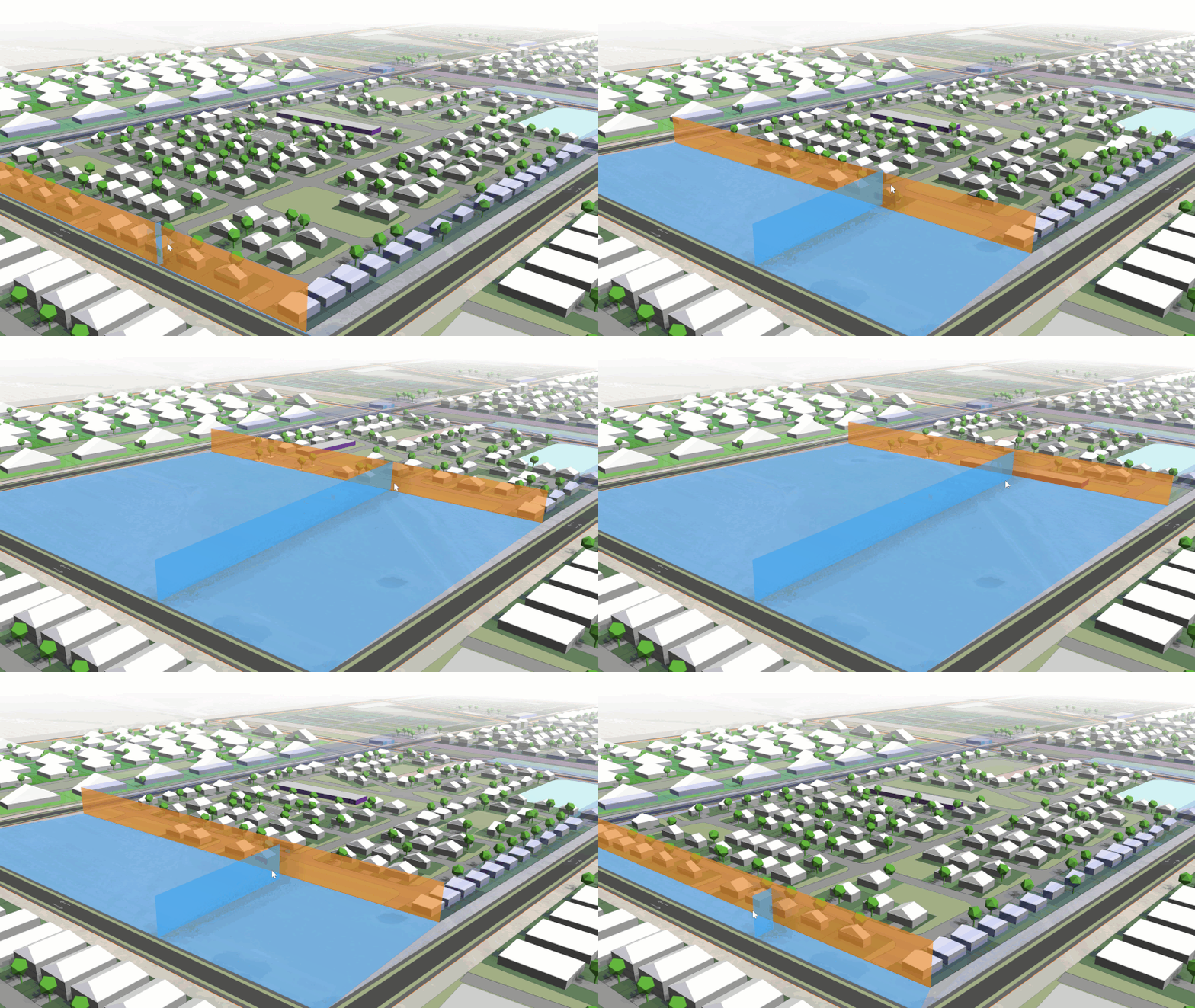
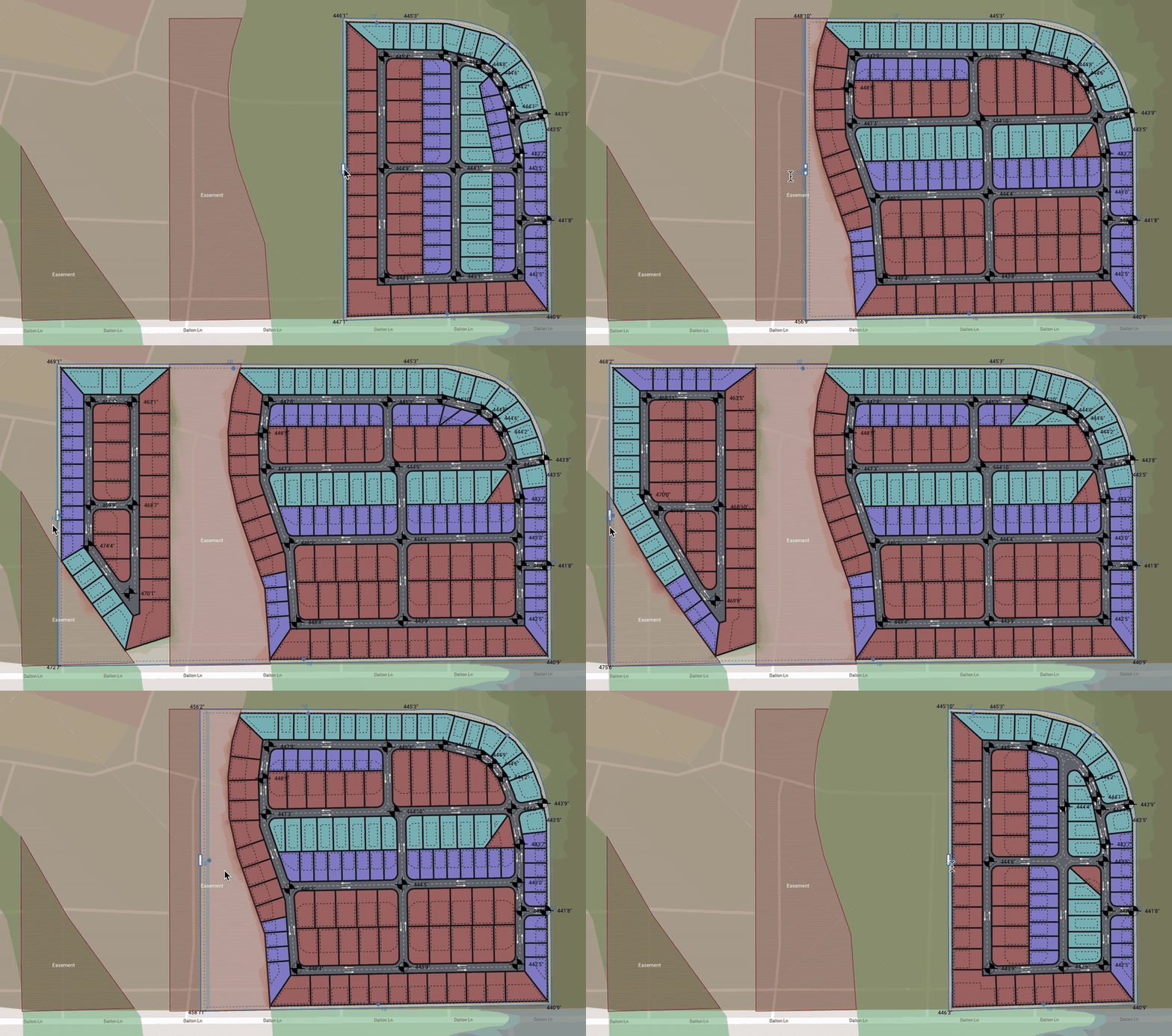
Topography, drainage patterns, flood zones, wetlands, and utility easements all reduce net developable area and constrain where lots and roads can go. Irregular parcel geometry creates additional challenges. Sites with non-orthogonal boundaries or corner conditions resist standard grid layouts and require more iterative planning to find the configuration that maximizes yield without leaving awkward residual land. Having that constraint data layered directly into the layout environment from the start is what Site Intelligence makes possible, so the first iteration already reflects reality rather than discovering problems mid-due-diligence.
Road and infrastructure network
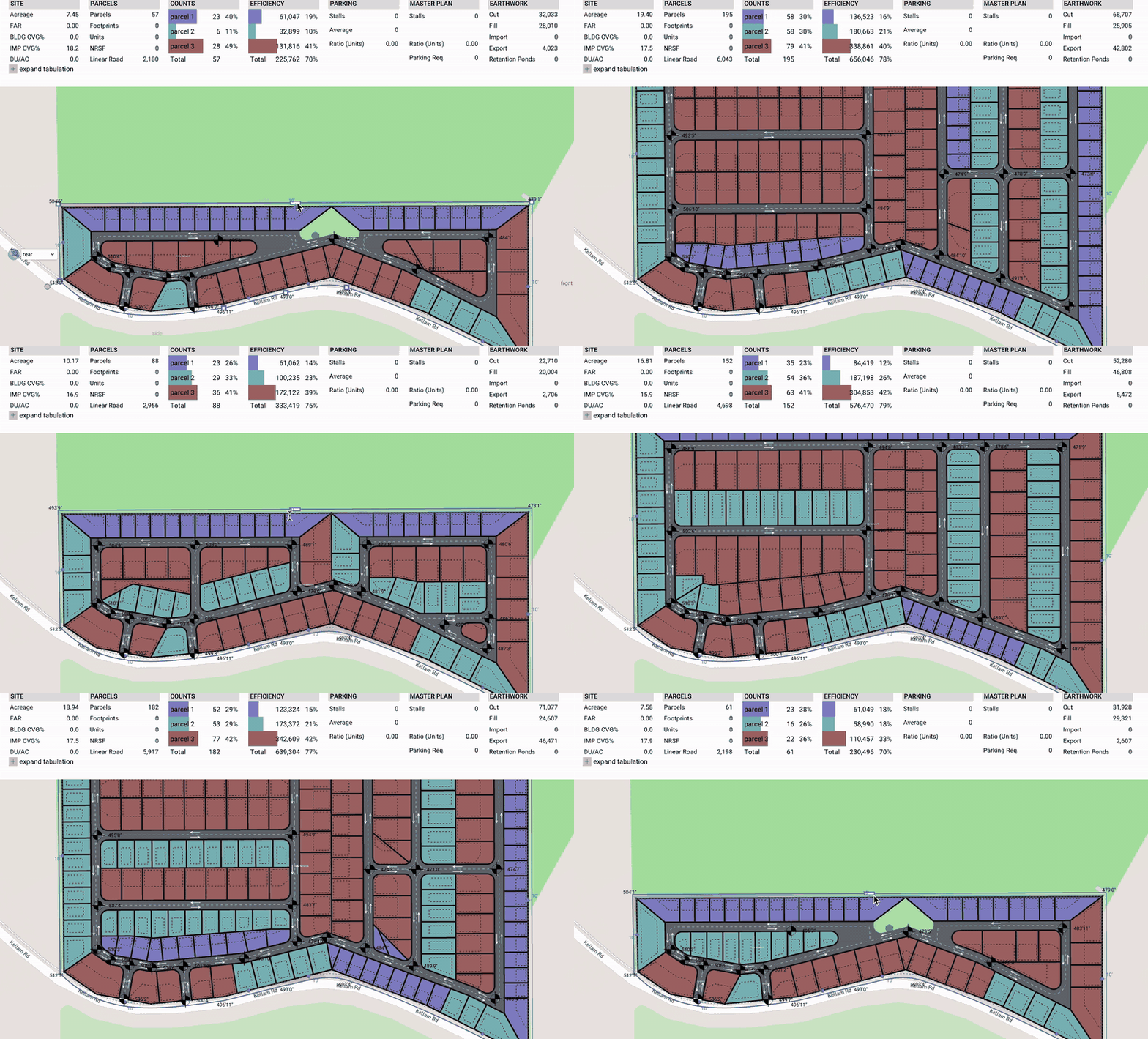
The street layout drives more than circulation. Road alignment determines how much land is consumed by rights-of-way, how infrastructure costs are distributed across the site, and how lots front up. A layout with long cul-de-sacs may feel efficient on paper but can produce higher per-lot infrastructure costs than a grid or loop road alternative. Street layout is critical to the financials of the deal.
IMAGE: TestFit road editor window or roads drawn in canvas
Lot mix
The dimensions of individual lots, their width, depth, and orientation, affect how many fit on a given net area. Narrower lots produce higher counts at the cost of reduced per-lot pricing in some markets. Wider lots command premium pricing but reduce yield. Finding the right mix requires testing configurations against both the site geometry and the local market, not just defaulting to a single standard.
How TestFit Helps Developers Move Faster
Subdivision layout has historically been slow. A developer identifies a site, engages a land planner, and waits days or weeks before a credible yield estimate comes back. By the time a layout is ready to stress-test against the pro forma, the deal may have already moved.
TestFit’s Single-Family platform changes that timeline. Developers can generate subdivision layouts directly within the tool, running multiple lot configurations, road networks, and parcel mixes for a given site in minutes. Zoning inputs, minimum lot dimensions, home type presets, and road requirements are built into the model from the start, so early iterations reflect real constraints rather than rough assumptions.
For sites that do not fit a clean grid, flexible parcels in TestFit extend layout capability to irregular and non-orthogonal parcels. Lot arrangements now follow corner conditions and organic site boundaries, which means higher yield and more marketable configurations on the kinds of challenging sites that are most common in land-constrained markets.
Lot counts, road lengths, and cost data update alongside the layout in real time, so the financial picture stays connected to the design as configurations change. Developers can test three or four layout scenarios in a single session and arrive at due diligence with a clear point of view on what the land is worth, rather than a question they are still trying to answer.
The BSB Design customer story shows what this looks like in practice. Their team achieved 4x faster turnaround on land planning work using TestFit, compressing a process that used to take weeks into something that happens in a single session.
Subdivision Starts With the Right Questions
The developers who execute subdivisions well are not necessarily the ones with the most experience. They are the ones who ask the right questions before they commit: What can this site yield after constraints are applied? What are the infrastructure costs at this configuration? Does the lot mix match the market? Is the spread between land cost and finished lot value justify the risk and timeline?
Those questions are answerable early. The tools exist to test them before the land goes under contract, before capital is committed, and before the layout is handed off to an engineer for construction documents.
If you are working through those questions on a current or prospective site, the TestFit Resource Center has case studies, ROI data, and product deep-dives worth reviewing.
Request a demo at testfit.io/sales