

In the fall of 2025, California's Debt Limit Allocation Committee awarded more than 2 billion dollars in private activity bonds to 108 affordable housing developments in a single round, a record for the state. The developments themselves were nothing unusual. What had changed, three months earlier, was the math that decided whether they could get built at all.
Federal law requires a 4 percent low income housing tax credit project to finance a share of its cost with tax exempt bonds before it can claim the credit. For nearly two decades that share sat at 50 percent, and in high demand states the tax exempt bonds needed to hit that number were often the scarcest piece of the entire capital stack. On July 4, 2025, new federal legislation cut that threshold to 25 percent for bonds issued after the end of that year. The credit itself did not get richer. The amount of bond debt required to unlock it simply got cut in half.
California moved first. Within 90 days, the state's tax credit and bond allocation committees adopted emergency regulations to implement the new threshold, making California the first state in the country to operationalize it. Georgia, Wisconsin, Colorado, Connecticut, and Delaware have each issued their own versions since, several settling on a stricter 28 or 30 percent floor rather than the federal minimum, but all moving the same direction.
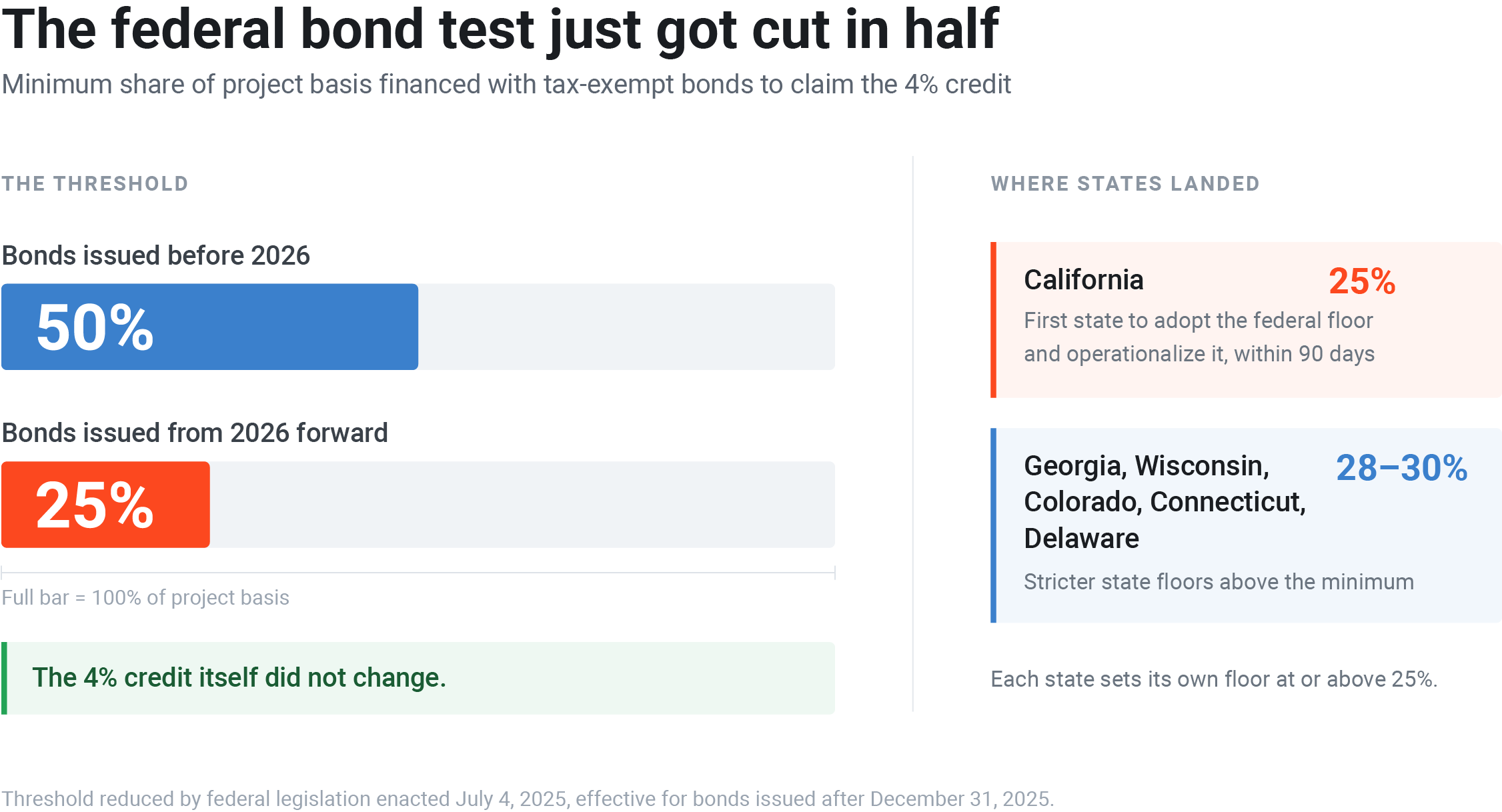
The scale of what that unlocks is still being estimated, but the early numbers are large. Novogradac projects the change could finance roughly 1.22 million additional affordable rental homes nationally between 2026 and 2035, with California alone accounting for close to 200,000 of them, followed by Georgia at around 98,000 and Texas at roughly 97,000.
For developers, the more immediate effect is on projects that already existed on paper. A 4 percent deal that got tabled in the last several years because it could not support 50 percent of its basis in bond debt is now a candidate for re underwriting, since the same project may support the debt load at 25 percent instead. Advisors in the space have been direct about it. Any project rejected under the old test should be re-modeled, because the capital stack assumptions changed, not the deal itself.
None of this means bond capacity is unlimited. Most states had been issuing their full allowable volume of private activity bonds for years, a condition the industry calls oversubscription, and the new test does not add a single dollar of bond cap to a state's annual allocation. It simply means each dollar of bond cap can now support roughly four times as many projects as it could before, which is a different kind of scarcity than the one developers were used to managing.
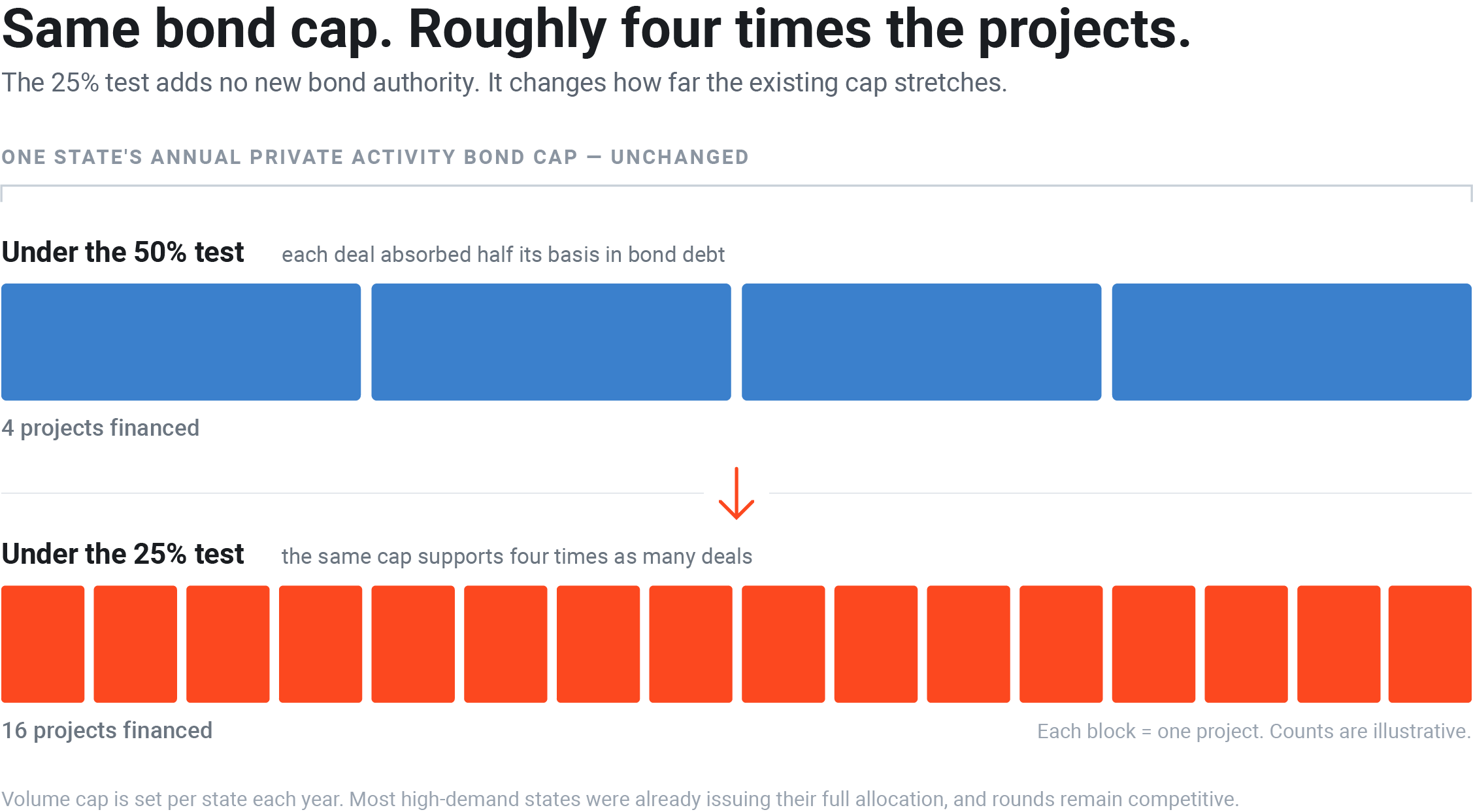
That shift moves the real bottleneck somewhere new. A project that was mathematically dead a year ago can be alive today, but only if a developer can prove it out fast enough to compete for a newly crowded allocation round, and most states still run these as competitive scoring processes rather than first come first served. The sites worth a second look are not always the ones already sitting in an active pipeline. Some of the best candidates are sites that got passed over years ago because the unit count never penciled under the old bond math, and nobody has opened that file since.
Testing a site's unit yield and unit mix against updated financing assumptions, across an entire back catalog of shelved deals, used to take a design team weeks per site. TestFit lets affordable housing developers run density, unit mix, and parking scenarios across a whole pipeline of sites in the time it used to take to model one, which matters more this year than most, since the sites worth revisiting are not always the ones anyone remembers to look at twice.

Has anyone actually re-run the numbers on the deals that got shelved under the old 50 percent test at your firm? Book a demo to find out if TestFit is right for your team.