No state moved more in the latest TestFit data than California.
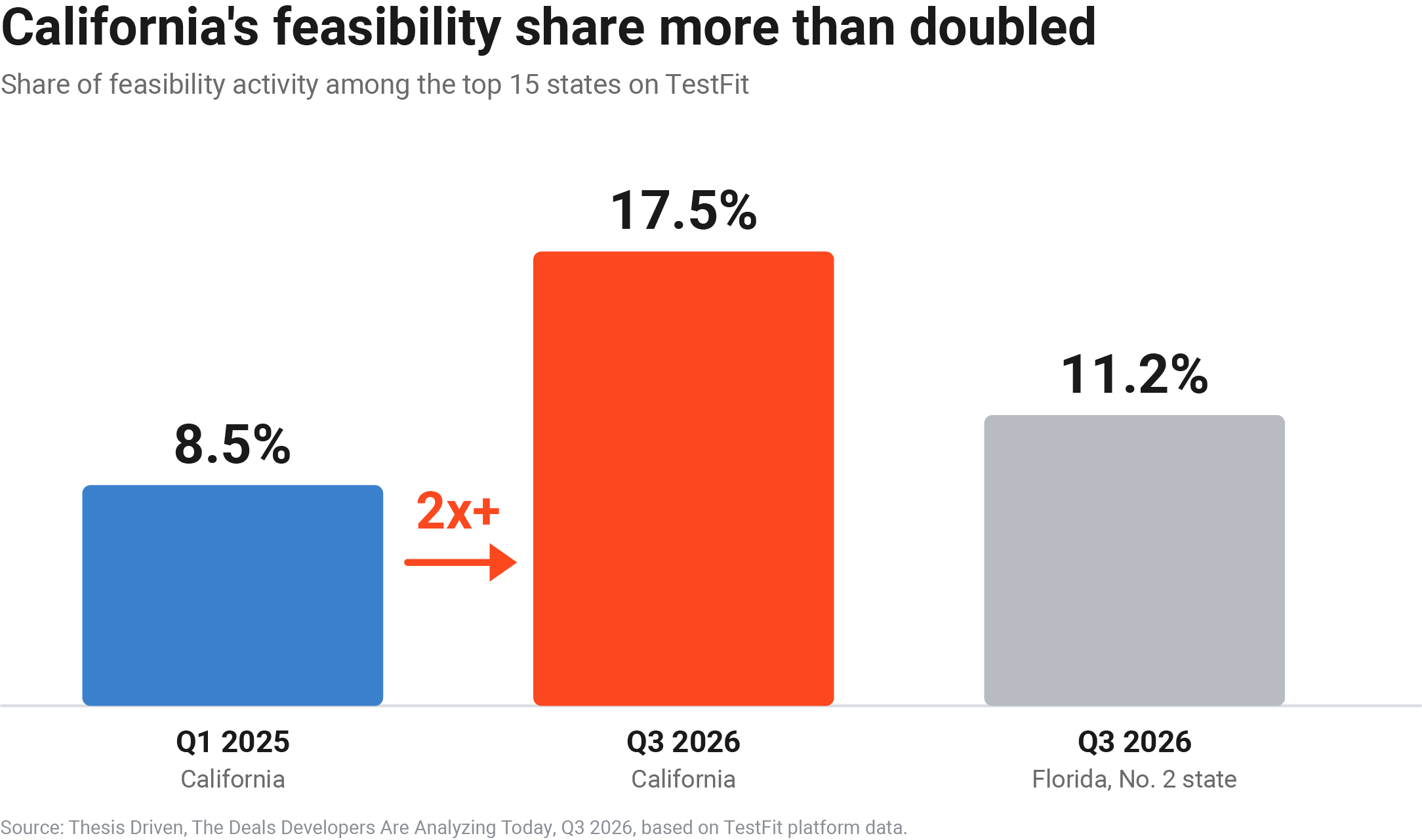
According to the Q3 2026 edition of The Deals Developers Are Analyzing Today, California's share of feasibility activity among the top 15 states on TestFit rose from a low of 8.5% in Q1 2025 to 17.5% in Q3 2026. That is more than double. Florida is a distant second at 11.2%.
California now generates more feasibility activity than any other state in the dataset. That lead matters because feasibility runs happen months before a permit application or a groundbreaking. They show where developers are spending time today, not where cranes stand today.
The biggest driver is a single change to federal affordable housing finance.
The policy behind the surge
The July 2025 federal "One Big Beautiful Bill" lowered the 4% Low-Income Housing Tax Credit bond test from 50% to 25%.
Here is why that matters. To qualify for 4% LIHTC equity, a project has to finance a minimum share of its costs with tax-exempt private activity bonds. Every state has a limited annual allocation of those bonds, and for years that cap limited how many affordable deals a state could support.
Cutting the test from 50% to 25% means each project needs about half as much bond volume. The same allocation can now support roughly twice as many affordable deals.
In high-demand states, bond volume was often the scarce resource. Good projects waited in line for an allocation, sometimes for more than one round. When each deal needs half the bonds, that line moves faster.
Thesis Driven also notes that projects shelved under the old 50% test are now candidates for re-underwriting. That means the opportunity is not only new sites. It is also the folder of deals that did not pencil two years ago.
A worked example (illustrative)
Here is a simple way to see the math. Assume a hypothetical project with $60 million of aggregate basis, the cost base the bond test is measured against. Assume a state has $300 million of bond volume for affordable deals this year.
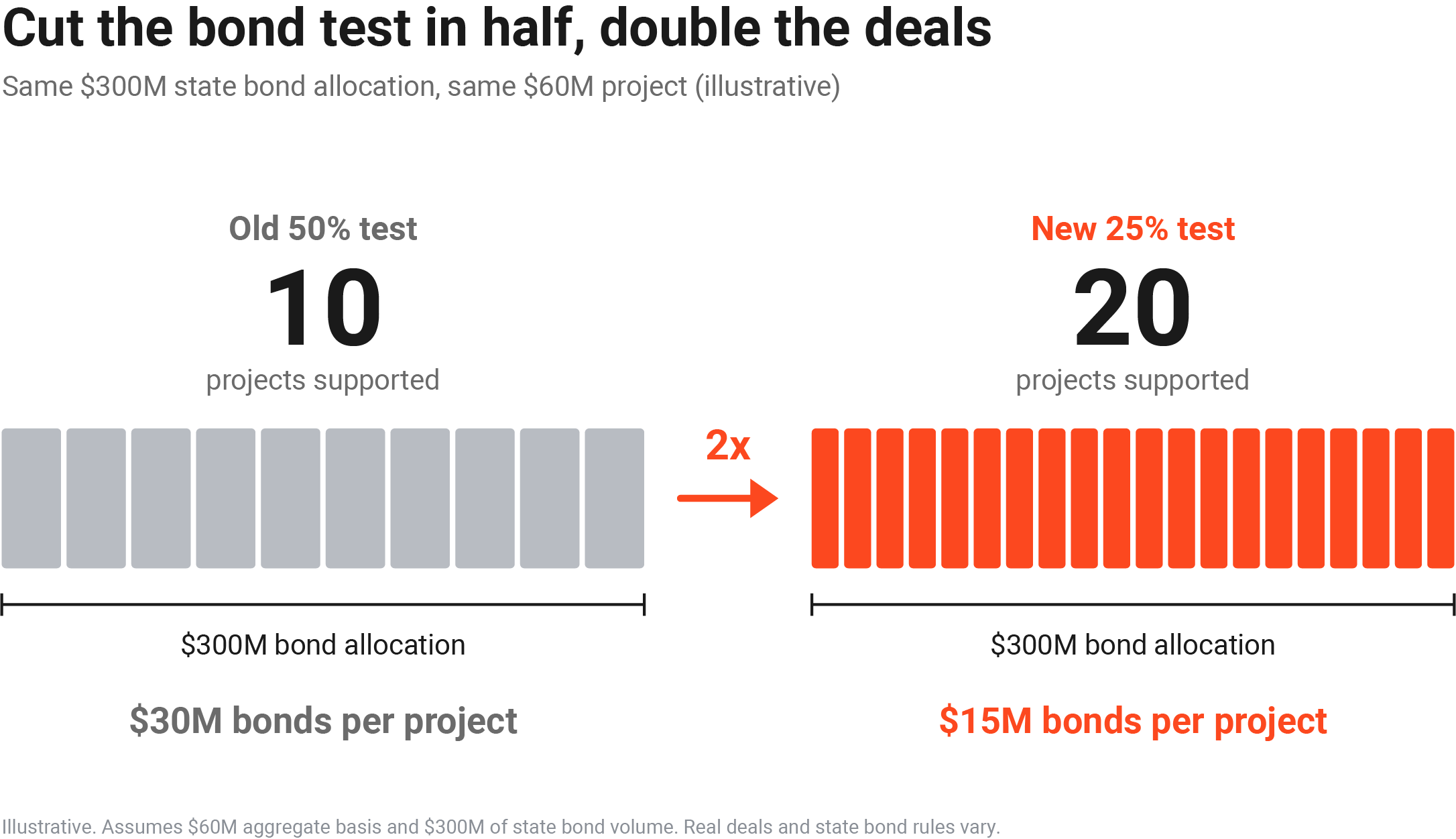
Same allocation, same project size, twice the deal count. These figures are assumptions for illustration, not data from any state. Real deals vary in size, and bond rules differ by state.
California moved first
California implemented the change within 90 days, faster than any other state. Novogradac projects the change could support 200,000 additional affordable homes in California over the next decade.
Speed matters here. When a state adopts the change early, its developers get a head start on site selection, design and underwriting. The jump in California feasibility activity is what that head start looks like in the data.
The bond test change also landed on top of years of California housing reform that had already made more sites viable:
- SB 9, allowing lot splits and duplexes on many single-family parcels
- AB 2011, allowing housing on many commercially zoned sites
- SB 423, extending streamlined approvals for qualifying housing projects
- AB 2097, removing parking minimums near major transit
- Expanded density bonuses for projects that include affordable units
Together, these laws give affordable housing developers more sites, faster approvals, and more units per site. The bond test change gives them the financing capacity to use it.
A bit more detail on two of these. SB 423 extends California's SB 35 streamlining from 2026 to January 1, 2036, and opens parts of the Coastal Zone to it. AB 2097 bars local parking minimums within one-half mile of a major transit stop, such as a rail station or a crossing of frequent bus routes, with limited exceptions.
Each law changes the inputs of a feasibility study. A commercial parcel that was off the table may now hold housing. A transit-adjacent site may carry far less parking. A density bonus may add a floor or a wing. The only way to know is to test the site with those rules in place.
Who's next
California is not alone. Georgia, Connecticut, Colorado, and Delaware have also implemented the bond test change, and Thesis Driven expects those states to show up in future feasibility data.
For affordable housing developers, the opportunity is to get ahead of each state's rollout. The developers who test sites early will be ready when the bond capacity opens up.
A practical approach is to build a short list of candidate parcels in each early-adopter state now. Screen them for yield and constraints before the next allocation round. When the round opens, you are submitting proven projects instead of starting from scratch.
The outlier: Arizona
Not every state is rising. Arizona's share fell from 6.9% in Q2 2026 to 1.1% in Q3, the largest proportional quarter-over-quarter drop in the dataset. Possible causes include water constraints, cost inflation, or simple noise in a single quarter. Phoenix is a market to watch in the next edition.
One quarter is not a trend. Still, a drop that sharp is worth tracking, especially for developers with land positions in the region.
What affordable housing developers should test now
The bond test change shifts what makes a California site attractive. Early feasibility should answer:
- How many units fit under base zoning and with a density bonus
- What unit mix meets the affordability levels the financing requires
- How much parking is actually needed, especially near transit under AB 2097
- Whether a commercial site qualifies for housing under AB 2011
- What the site constraints are, including flood zones, easements, and utilities
With twice the financing capacity available, the bottleneck shifts to finding and proving the right sites quickly.
The five questions above connect. More units change the parking count. Less parking frees land for more units or open space. Unit mix changes the rents, which changes how much debt and equity the deal supports.
How the inputs stack up on one site (illustrative)
Take a hypothetical 3-acre site within a half mile of a rail station. Assume base zoning allows 40 units per acre and the project qualifies for an assumed 50% density bonus.
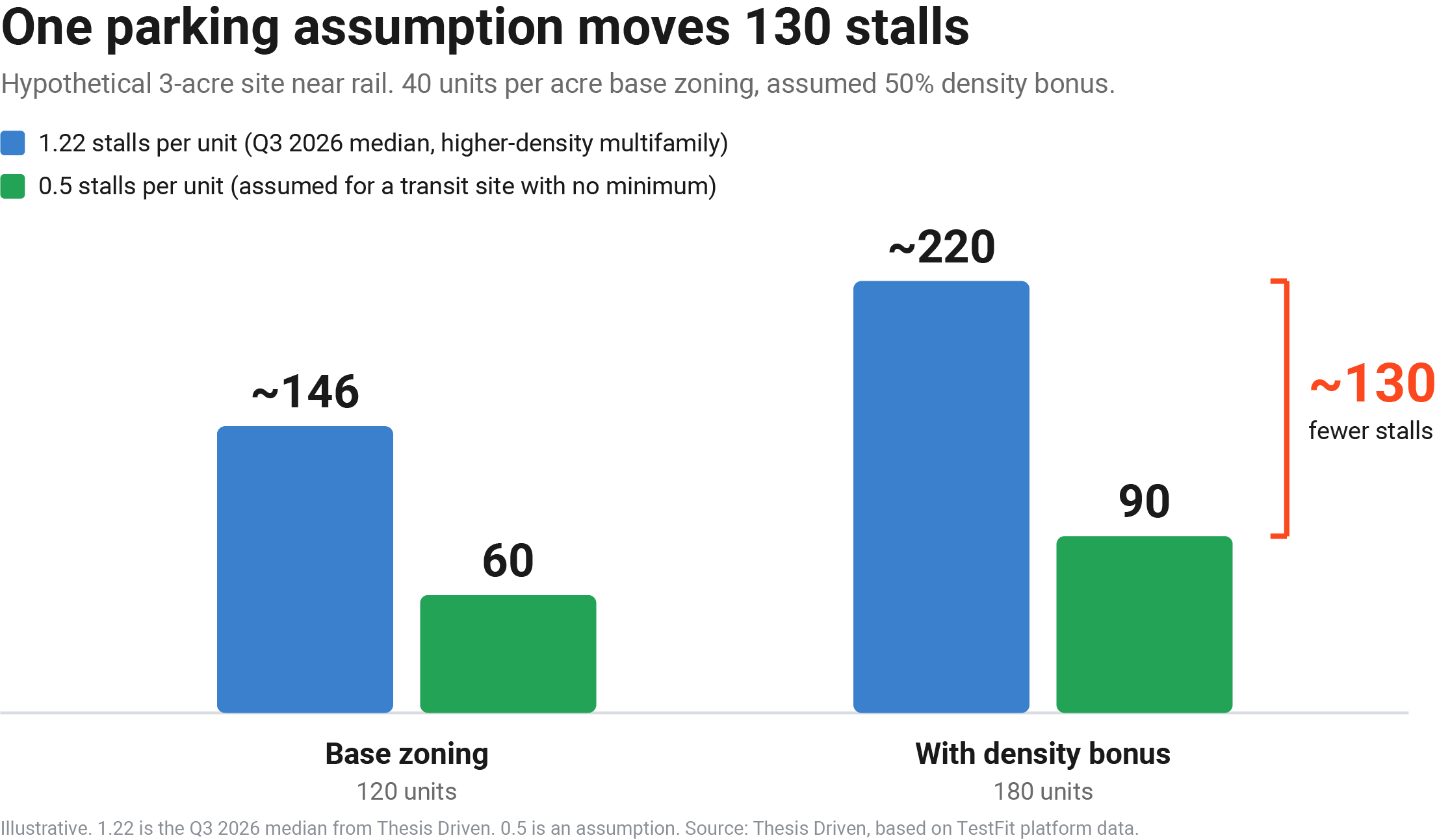
The 1.22 figure is the Q3 2026 median parking ratio for higher-density multifamily in the Thesis Driven report. The 0.5 figure is a simple assumption for a transit site with no parking minimum. At 180 units, that choice is the difference between about 220 stalls and 90 stalls.
Those roughly 130 stalls are land, structure and cost. On a tight affordable budget, that can decide whether a deal works. The real number depends on the market, the lender and the tenants, which is why it should be tested, not assumed.
Frequently asked questions
What is the LIHTC 25% bond test?
To earn 4% Low-Income Housing Tax Credits, a project must finance a minimum share of its aggregate basis with tax-exempt private activity bonds. The July 2025 federal law lowered that minimum from 50% to 25%. Each deal now needs roughly half the bond volume.
Why did California's feasibility activity jump?
California implemented the bond test change within 90 days, first among the states. That change stacked on years of reform such as SB 9, AB 2011, SB 423 and AB 2097. TestFit data shows California's share of feasibility activity rising from 8.5% to 17.5%.
Which states adopted the bond test change after California?
Thesis Driven names Georgia, Connecticut, Colorado and Delaware. The report expects those states to appear in future feasibility data as developers respond.
Should developers revisit shelved affordable deals?
Yes. Thesis Driven notes that projects shelved under the old 50% test are candidates for re-underwriting. A fresh feasibility run with current rules and costs is the fastest way to see which ones now work.
Why TestFit is the authority on where development is heading
TestFit saw the California surge in real time because developers test their sites in TestFit before anyone else hears about the deal. With more than 100,000 site analyses last quarter, and nine consecutive quarters of tracking with Thesis Driven, TestFit's state-by-state data is one of the clearest early signals of where housing will be built next.
For more than a decade, TestFit has been the feasibility platform developers and architects use to answer the first question on any deal: what fits, and does it pencil? That volume of early-stage work is why the data leads the market instead of trailing it.
TestFit's 2026 ROI report shows what that speed means in practice. Survey respondents cut feasibility time by 80%, from 11 to 25 hours per study to 0 to 5. Developers save 18 hours per feasibility study and create 5x more design iterations per site. Respondents make go/no-go decisions 1.5x faster.
Customers see the same pattern. Trinity Commercial Group cut site planning from 30 days to a week. Prince Property Group can create 12 schemes in one sitting and sizes up a site in 10 minutes. Sami Khoury, a principal at AC Martin, averages at least one feasibility study a day for clients.
TestFit is also built for the affordable housing work this policy is creating:
- Fast unit yield on any site, so you can screen many California parcels quickly
- Unit mix and density testing, with live tabulations as you adjust the program
- Parking that responds to the rules, whether the site needs full parking or none at all
- Generative design that explores configurations and ranks them by yield
- Site intelligence with parcels, flood zones, wetlands, and utilities in the same view
TestFit calculates, it does not guess. When bond capacity doubles, the developers who can prove a site fastest will build the most housing.
The pro forma runs on the solved geometry, so the numbers update when the site plan does. Unlimited users and shareable deals mean lenders, capital partners and land sellers can all see the same scheme.
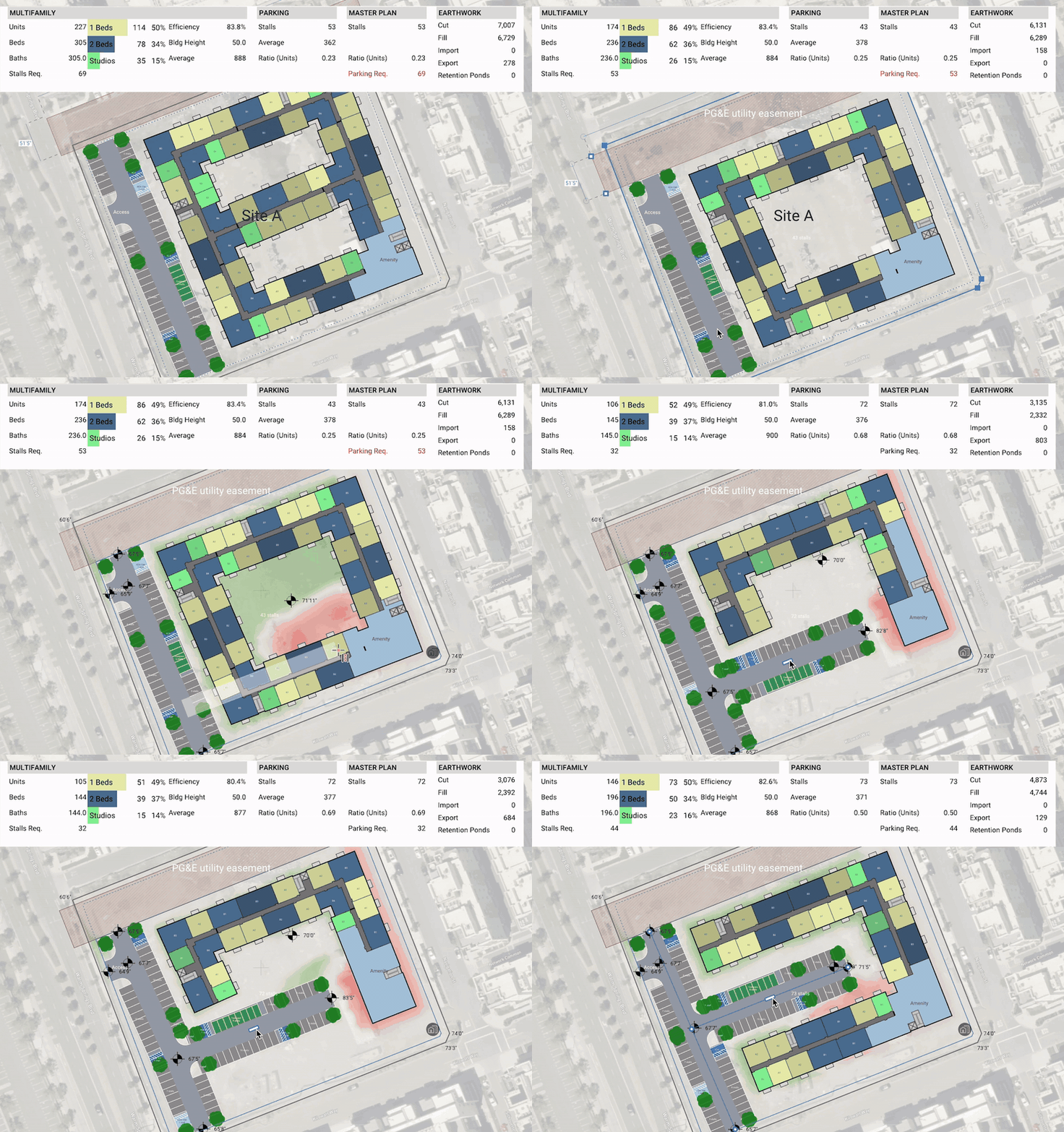
Building affordable housing in California or another early-adopter state? Book a quick demo for affordable housing developers.
Source: Thesis Driven, The Deals Developers Are Analyzing Today, Q3 2026 Edition, based on TestFit platform data.