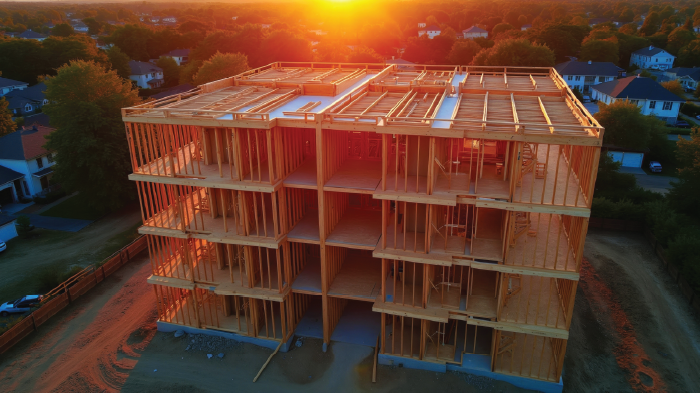

A year and a half ago, a developer could open a high-density multifamily deal, work through it, and reach a decision in about three weeks. Today the same kind of deal stays open for more than three months.
That finding comes from the Q3 2026 edition of The Deals Developers Are Analyzing Today, Thesis Driven's quarterly analysis of TestFit platform data. A high-density multifamily deal that wrapped in Q2 2025 averaged 21 days from first save to last. The Q3 2026 equivalent averaged 106 days. That is nearly five times longer.
For anyone who owns a multifamily feasibility study timeline, that shift matters. It changes how many sites a team can chase, how long land stays tied up, and who wins the deals that do pencil.
The good news is that the data also points to where the time goes. And time that is spent waiting is time a team can win back.
The work did not grow. The waiting did.
The most revealing number is not the 106 days. It is how many of those days developers actually spent working.
Mean active days, the days a user was working in the file, rose from about 3 to 7. So a deal that now stays open for 106 days gets roughly a week of real attention. The other 99 days are gaps between sessions.
Here is how the two periods compare:
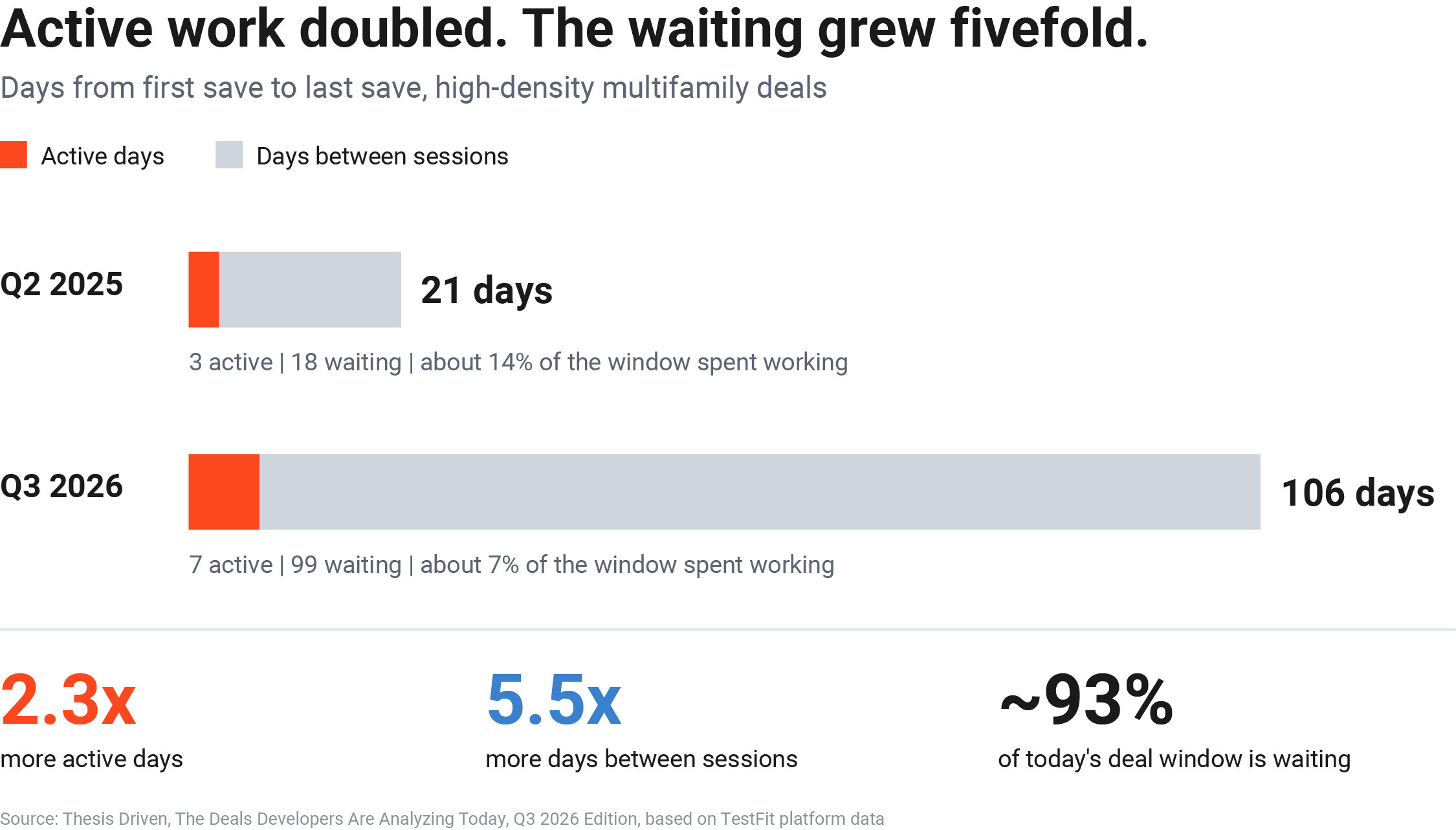
Active work a little more than doubled. The idle time grew more than fivefold. Put another way, developers now spend about 93% of a deal's open window waiting on something.
That tells us the delay is not about how long it takes to model a site. It is about how many times developers come back to it, and how long they wait in between.
This is a useful distinction. A slow tool is hard to fix from the outside. A slow loop between people and decisions is something a team can redesign this quarter.
What fills the gaps
Developers are returning to deals again and again to test variants and refine assumptions. Thesis Driven attributes this to the development math, not the software, and the pattern makes sense in today's market:
- Rerunning schemes as inputs change. Construction pricing, rent comps, and interest rate expectations shift during the evaluation, and each shift sends the developer back to the model.
- Testing alternatives. With dense multifamily now under half of residential activity, more developers test a podium against a garden or townhome option before committing.
- Waiting on partners. Capital partners, lenders, and land sellers each review the deal on their own timeline, and each round of questions brings a new variant.
- Waiting on design input. When every new scheme requires a drawing, the developer waits on the design team before the next question can be answered.
The market context explains why each loop is happening. The same report shows higher-density multifamily falling from 61.6% of residential feasibility runs in Q3 2024 to 45.2% in Q3 2026. Garden-style rose to 10.3%, a dataset high.
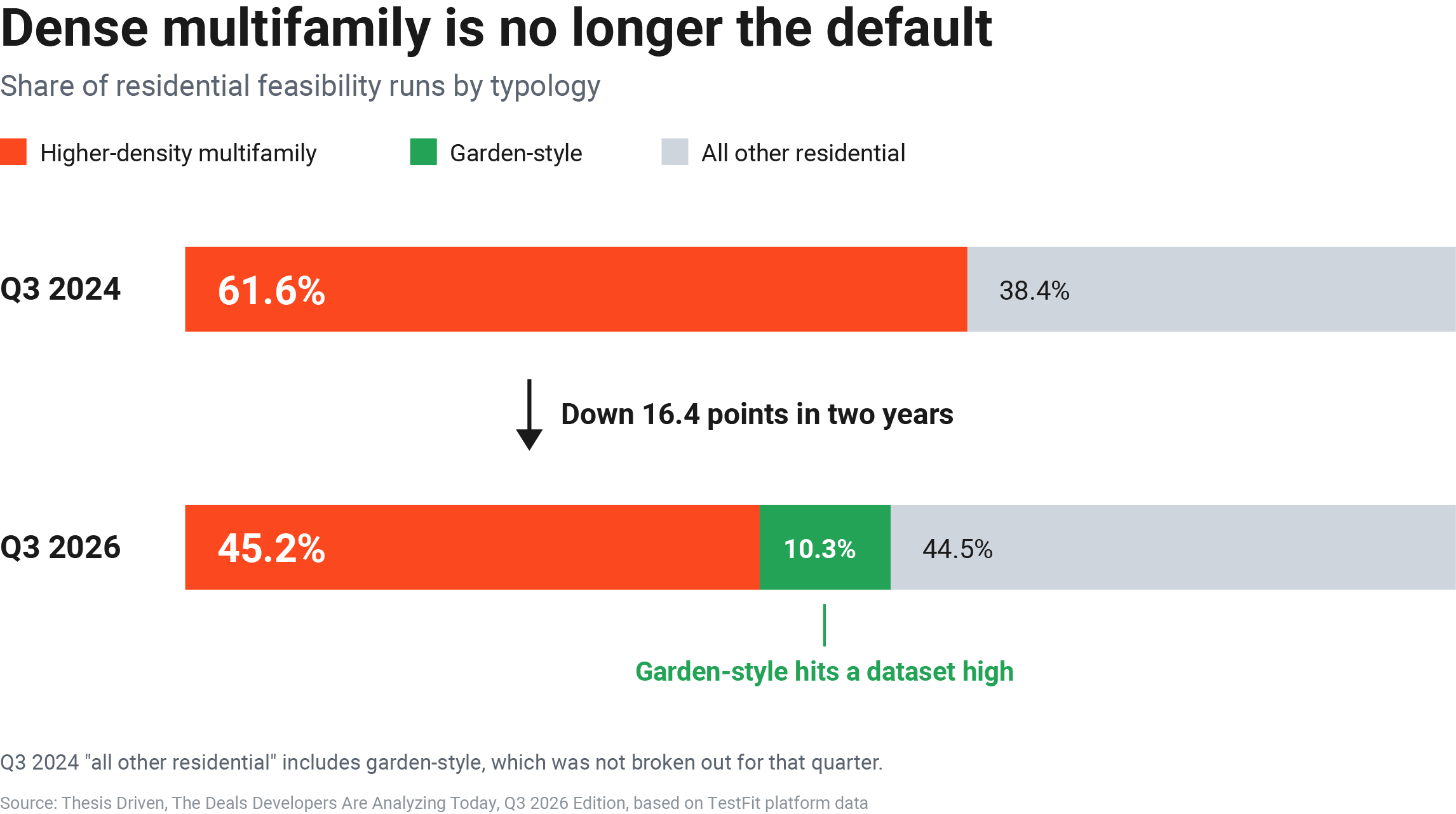
When the obvious answer stops working, developers test more answers. A site that would have gone straight to a five-story podium two years ago now gets a garden scheme, a townhome scheme, and a smaller podium as well.
Construction costs add another layer. The report notes that costs have not eased the way rates have. So a developer may rerun the same scheme three times as a general contractor's pricing comes in, without changing a single line of the plan.
None of these loops are wasted effort. The issue is that each one sits in a queue. A question raised on Monday gets an answer two weeks later, and that answer raises the next question.
The cost of a slow answer
A long evaluation is not free. Every week a deal stays open carries real costs.
- Option and deposit periods run out. Land under contract has a clock, and 100 days uses most of a typical due diligence window.
- Team bandwidth gets stretched. An acquisitions team juggling ten open deals for three months each can pursue fewer opportunities per year.
- Good sites go to faster buyers. In a market where fewer deals pencil, the developer who reaches a confident yes first often wins the site.
There is also a quieter cost. The longer a deal stays open, the more the assumptions drift. A rent comp pulled in week one may be stale by week twelve, which can trigger yet another round of revisions.
An illustrative example
Here is a hypothetical deal to show how the numbers play out. The site and terms are invented for illustration.
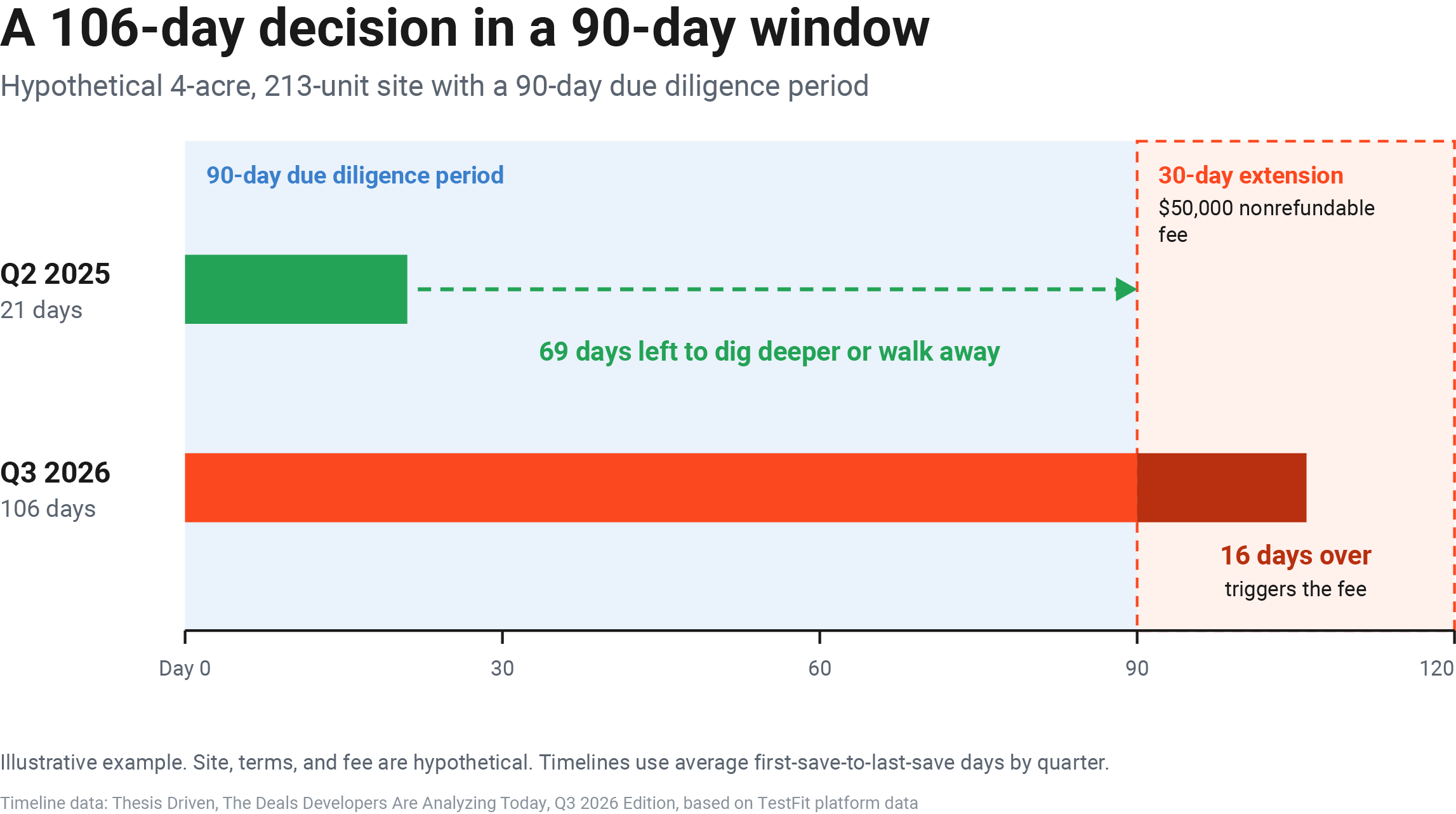
Picture a hypothetical 4-acre multifamily site under contract with a 90-day due diligence period. The developer is testing a scheme near the report's Q3 2026 median of 213 units, about 53 units per acre.
- At the Q3 2026 pace of 106 days, the evaluation runs 16 days past the 90-day window. Assume the seller offers one 30-day extension for a $50,000 nonrefundable fee. The developer pays it just to finish deciding.
- At the Q2 2025 pace of 21 days, the decision lands with 69 days left in the window. That leaves room for deeper diligence, or for walking away with the deposit intact.
Now scale that to a team. Say an acquisitions group can keep ten deals open at once.
- At 106 days per deal, each slot turns over about 3.4 times a year (365 divided by 106). That is roughly 34 decisions a year.
- At 45 days per deal, each slot turns over about 8.1 times a year (365 divided by 45). That is roughly 81 decisions a year.
Same team, same headcount, more than twice the deal flow. The active work per deal does not need to shrink at all. Only the gaps do.
How to shorten the evaluation
The goal is not to rush the decision. It is to remove the dead time between sessions.
- Set kill criteria before the first run. Define the minimum yield, unit count, or return that makes the deal worth pursuing, so every session either clears the bar or ends the pursuit.
- Run the variants in one sitting. Instead of testing one scheme per session, generate the full range of typologies, unit mixes, and parking options at once.
- Tie the design to the numbers. When the pro forma updates as the scheme changes, there is no separate round trip to a spreadsheet.
- Share live schemes with partners. A shared, interactive model answers a partner's question in the meeting instead of a week later.
- Bring architects in with a tested scheme. Design time is spent refining a site that already works, not proving that it does.
A few practical habits help each step stick:
- Write the kill criteria into the deal file. When a lender or capital partner asks why a scheme was dropped, the answer is already there.
- Stress test inputs up front. Run the base case with a high and low construction cost and rent assumption in the first session. Later price updates then confirm a range instead of starting a new loop.
- Bundle partner questions. Collect questions from lenders, capital partners, and land sellers into one review, and answer them live against the model.
- Track your own cycle time. Measure first save to decision on every deal. If your team sits near 106 days, even a move to 45 days changes your year.
Frequently asked questions
How long does a multifamily feasibility study take in 2026?
According to Thesis Driven's analysis of TestFit platform data, high-density multifamily deals averaged 106 days from first save to last in Q3 2026. That is up from 21 days in Q2 2025. Developers actively worked on the deal for only about 7 of those days.
Why are multifamily deals taking longer to evaluate?
Thesis Driven attributes the change to development math, not software. Developers are testing more variants and tightening assumptions as costs, rents, and rates shift. Most of the added time is the gap between sessions, not the work itself.
What is the fastest way to shorten a feasibility timeline?
Remove the waiting between sessions. Set kill criteria early, run typology and parking variants in one sitting, and tie the design to the pro forma. Then share a live model so partner questions get answered in the meeting.
Does a faster evaluation mean a riskier decision?
Not when the work is the same. The data shows active days rising from about 3 to 7, which suggests teams are doing more careful work. Compressing the idle days keeps that rigor while giving back time on the due diligence clock.
Why TestFit is built for this problem
The 106-day figure is visible because developers do their feasibility work in TestFit. No other dataset tracks how long deals take to evaluate across more than 100,000 site analyses a quarter, because no other platform sits this close to the moment a developer decides whether a site works.
TestFit and Thesis Driven have now tracked that activity for nine quarters. That gives the industry a running view of what developers test, how dense they build, and how long they take to decide, well before any of it shows up in construction starts.
For more than a decade, TestFit has been where developers answer that question. And it is built to compress exactly the gaps this data reveals:
- Generative design produces and ranks many configurations in one session, so a variant does not wait for the next meeting.
- Live tabulations and pro forma update unit counts, parking, and returns as the scheme changes, connecting design and financials in one place.
- Typology flexibility lets you compare podium, wrap, garden, and townhome options on the same site without starting over.
- Unlimited users and shareable deals mean partners, lenders, and architects can see the same model, so questions get answered when they are asked.
- Site intelligence brings parcels, flood zones, wetlands, and utilities into the first run, so fewer surprises force a return visit.
- Responsive parking lays out stalls and drive aisles as surface, structured, or tuck-under parking, and updates as the massing changes.
The results show up in how customers work. In TestFit's 2026 ROI report, survey respondents cut feasibility time by 80%, from 11 to 25 hours per study down to 0 to 5. Developers save 18 hours per feasibility study and create 5x more design iterations per site.
Those gains move decisions. Respondents make go/no-go decisions 1.5x faster. Trinity Commercial Group cut site planning from 30 days to a week.
Prince Property Group can create 12 schemes in one sitting and sizes up a site in 10 minutes. On the design side, Sami Khoury, a principal at AC Martin, averages at least one feasibility study a day for clients.
That is the pattern this data calls for. More variants per session, fewer sessions per deal, and less time waiting in between. Learn more about how developers use TestFit across the full evaluation.
TestFit calculates, it does not guess. That is how a developer gets from a site to a confident decision in days instead of months.
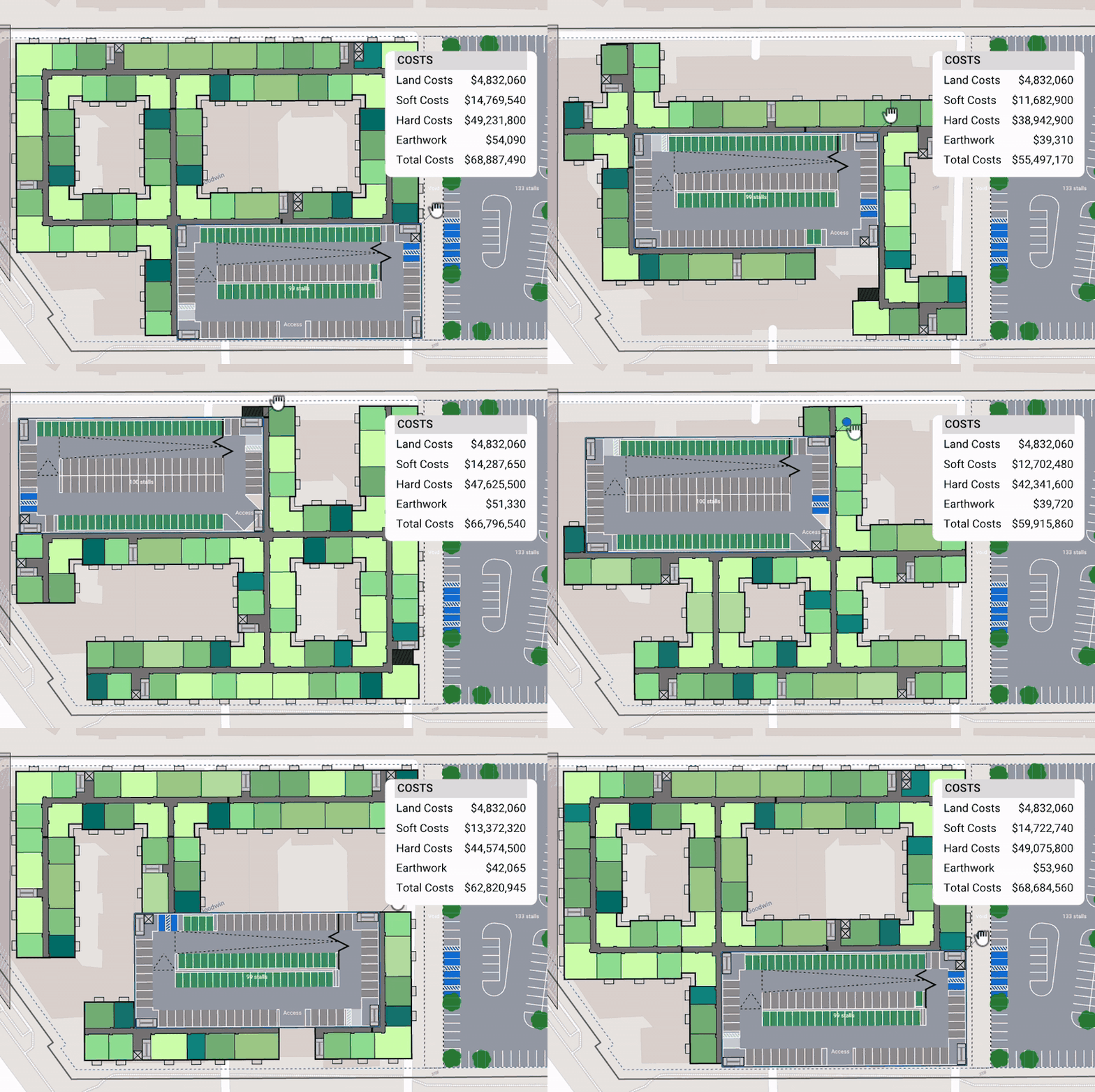
Want to see how fast your next deal can move? Book a quick demo focused on scenario comparison.
Source: Thesis Driven, The Deals Developers Are Analyzing Today, Q3 2026 Edition, based on TestFit platform data.