
Retail development is back, and it is thinking bigger.
TestFit data in the Q3 2026 edition of The Deals Developers Are Analyzing Today shows retail sites getting much larger:
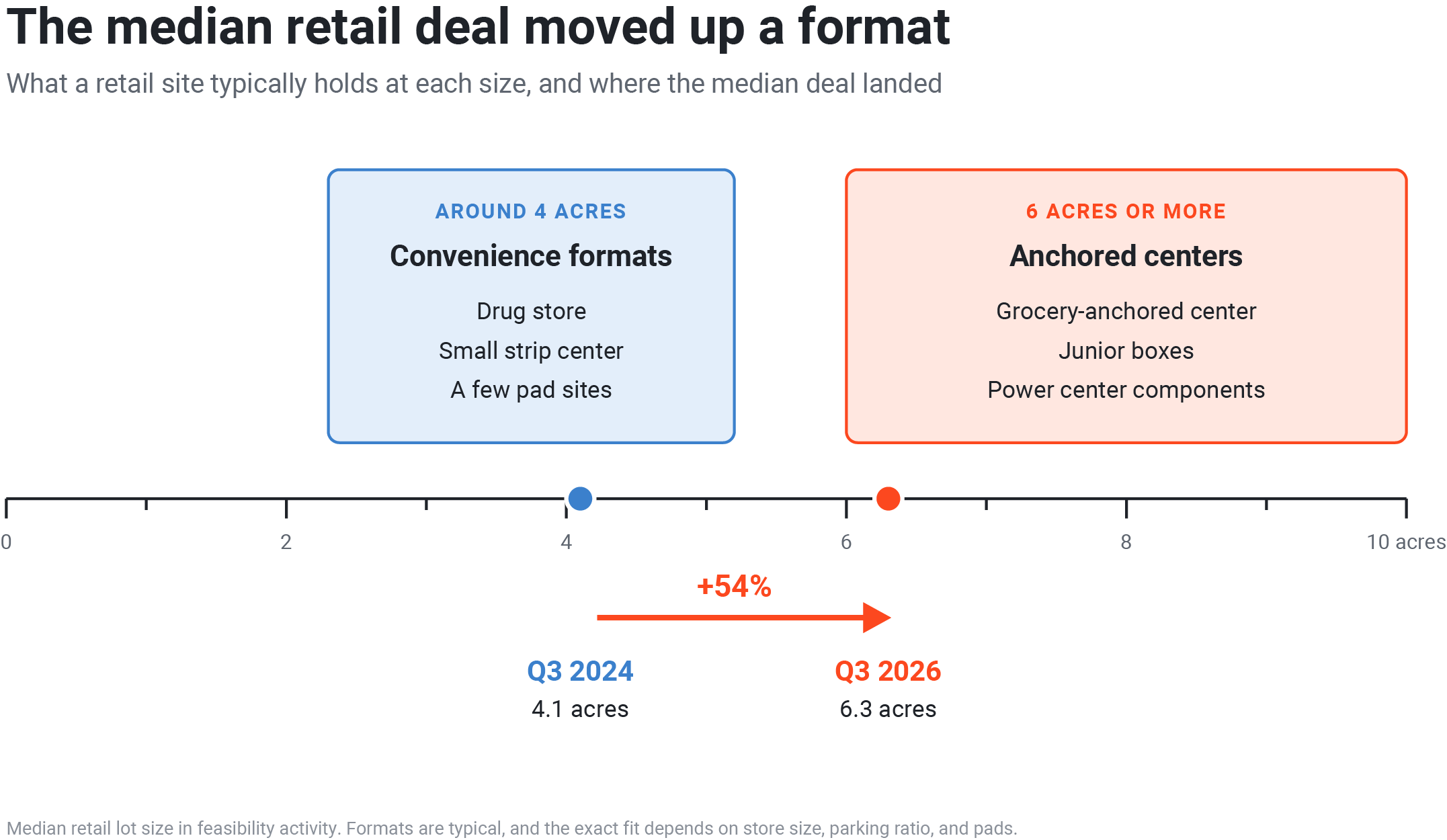
- Median retail lot size: up 54%, from 4.1 acres to 6.3 acres
- Median building area: up 58%, from 74,000 SF to 117,000 SF
That is not a small change in averages. It is a shift in the kind of retail project developers are pursuing.
These figures track feasibility activity, not construction starts. They show what developers are testing today, which is often a preview of what breaks ground in the next few years.
What the size change tells you
Site size is a strong clue to what a retail developer has in mind.
- Around four acres typically holds a drug store, a small strip center, or a few pad sites.
- Six acres or more typically holds a grocery-anchored center, junior boxes, or components of a power center.
When the median site grows from 4.1 to 6.3 acres, the typical retail deal is moving from small convenience formats toward anchored centers with more tenants, more parking, and more value.
One detail stands out. Building area grew a little faster than land, so developers are not just buying bigger lots. They are planning more building on each acre.

That ratio matters. An anchored center has to fit a large box, in-line shops, pads, truck access, and a big parking field. Holding density steady while the program gets more complex leaves less slack in the plan.
Three forces behind bigger retail sites
1. Grocers are expanding
Grocery-anchored construction is leading the way. Publix, H-E-B, Kroger, and regional grocers are opening new stores across Sun Belt and secondary markets, often following the population growth that the last housing cycle brought. Each new grocery store needs a large site and brings in-line tenants and outparcels with it.
Grocery anchors drive daily trips, and daily trips are what in-line tenants and pad users want. That is why a grocer often unlocks a whole center, not just one building.
It also raises the bar on site selection. Grocers tend to have firm requirements for store size, frontage, loading, and parking. A site that cannot meet them rarely gets a second look, so developers need to prove fit early.
2. Dead malls and parking lots are being redeveloped
Large, underused retail properties are becoming some of the best development sites in the country. Aging malls and oversized parking fields offer big parcels in established locations, with roads and utilities already in place.
Bolsa Pacific in Orange County is a strong example. The 83-acre redevelopment of the former Westminster Mall includes a 210,000 SF Target-anchored retail component, 2,250 homes, a hotel, and a food hall. We covered this trend in depth in Parking Lot Redevelopment Is Retail's New Land Rush.
These sites come with a built-in advantage: the location already works. Shoppers know how to get there, and the surrounding neighborhoods are established.
They also come with harder questions. Existing leases, shared access agreements, and active tenants all shape what can move and when. The upside is a large, well-located parcel that rarely comes to market any other way.
3. Lenders are back
Financing has loosened. CBRE's Lending Momentum Index rose from 0.3 in early 2025 to 1.5 in early 2026, its highest level since 2021. With capital more available, developers can pursue larger, anchored projects that were hard to finance two years ago.
Returning capital rewards preparation. Lenders and capital partners still want to see a credible site plan, a realistic parking count, and a pro forma tied to real leasable area. Teams that can show those quickly get to term sheets first.
What to test early on a large retail site
Bigger sites bring bigger questions. Before a retail developer commits, the early feasibility work should answer:
- Anchor placement and visibility, so the grocer or junior box gets frontage and access
- In-line and pad layout, balancing leasable area against circulation and outparcel value
- Parking fields, sized to tenant requirements and arranged for access and drive-thru stacking
- Phasing, especially on redevelopment sites where existing tenants stay open during construction
- Mixed-use potential, since large sites like Bolsa Pacific increasingly pair retail with housing, hotels, or entertainment
- Site constraints, including easements, flood zones, utilities, and access points that limit what can go where
On a six-acre site, a small layout change can move a pad, add a tenant, or open up room for housing.
Truck access deserves its own check, too. Grocery loading docks need clear delivery routes that stay away from customer drives and parking fields.
A worked example: one grocer, two parking ratios
The numbers below are illustrative. They use a hypothetical 6.3-acre site, matching the new median, and simple stated assumptions.

"Everything else" is not empty land. It covers setbacks, landscaping, stormwater, the truck court, entry drives, and drive-thru stacking.
One extra stall per 1,000 SF takes 26,400 SF, more than half an acre. On a site this size, that can decide whether a second pad fits or whether stormwater needs a different solution.
The takeaway is simple. Tenant requirements and code ratios change the plan fast, so test them before the offer, not after.
How developers and architects can respond
Bigger retail sites reward teams that move early and test widely. A few habits help:
- Start with constraints. Map flood zones, wetlands, easements, and utilities before drawing a single box.
- Test several anchor positions. Frontage, access, and loading can push the anchor to a different corner than the first sketch.
- Run parking at more than one ratio. As the example shows, the ratio can reshape the whole site.
- Price the pads. Outparcels often carry strong value per acre, so their size and position deserve real study.
- Keep housing on the table. On redevelopment sites, a residential component can change the land math entirely.
Architects working for retail developers can add the most value here. Fast, credible options help clients decide which sites deserve full design work.
Brokers benefit as well. A broker who can show a land seller what a grocer, pads, and housing might yield on a site has a stronger listing story and a clearer price conversation.
Frequently asked questions
Why are retail development sites getting larger?
Grocery-anchored centers, dead-mall redevelopment, and improved financing are pushing developers toward bigger projects. TestFit data shows the median retail lot grew from 4.1 to 6.3 acres. Larger sites fit anchors, in-line tenants, and pads together.
How big a site does grocery anchored retail development need?
Sites of six acres or more typically hold grocery-anchored centers, junior boxes, or parts of power centers. The exact need depends on store size, parking ratio, and how many pads and in-line shops the plan includes.
What should I test first on a large retail site?
Start with site constraints, anchor placement, and parking. Those three choices drive how much leasable area fits and where pads can go. Phasing and mixed-use options come next on redevelopment sites.
Can retail and housing share a redevelopment site?
Yes. Projects like Bolsa Pacific pair a Target-anchored retail component with 2,250 homes, a hotel, and a food hall. Testing both uses in one plan shows how parking, access, and phasing interact.
Why TestFit is the authority on retail feasibility
The retail data above comes straight from what developers are testing in TestFit. With more than 100,000 site analyses last quarter across retail, residential, industrial, and mixed-use, and nine consecutive quarters of tracking with Thesis Driven, TestFit sees retail deal trends before they show up in leasing reports or construction starts.
That view comes from more than a decade as the feasibility platform developers, architects, and brokers use to size up land. When thousands of teams test real sites every week, the patterns in their work become a leading indicator for the market.
The results show up in the work itself. In TestFit's 2026 ROI report, survey respondents cut feasibility time by 80%, from 11 to 25 hours per study to 0 to 5. Developers save 18 hours per feasibility study, create 5x more design iterations per site, and make go/no-go decisions 1.5x faster.
Customer teams see the same pattern:
- Trinity Commercial Group cut site planning from 30 days to a week.
- Prince Property Group can create 12 schemes in one sitting and sizes up a site in 10 minutes.
- Sami Khoury, a principal at AC Martin, averages at least one feasibility study a day for clients.
TestFit is also built for the questions bigger retail sites raise:
- Retail and mixed-use layouts with anchors, in-line space, and pads on the real site
- Responsive parking that sizes and arranges stall fields around the buildings as they move
- Housing and retail on one site, so redevelopment teams can test a Bolsa Pacific style plan in a single model
- Live tabulations for leasable area, coverage, and parking as the layout changes
- Site intelligence with parcels, flood zones, wetlands, and utilities, so large sites start with real constraints
TestFit calculates, it does not guess. On a large retail site, that means knowing what the land can hold before you make an offer.
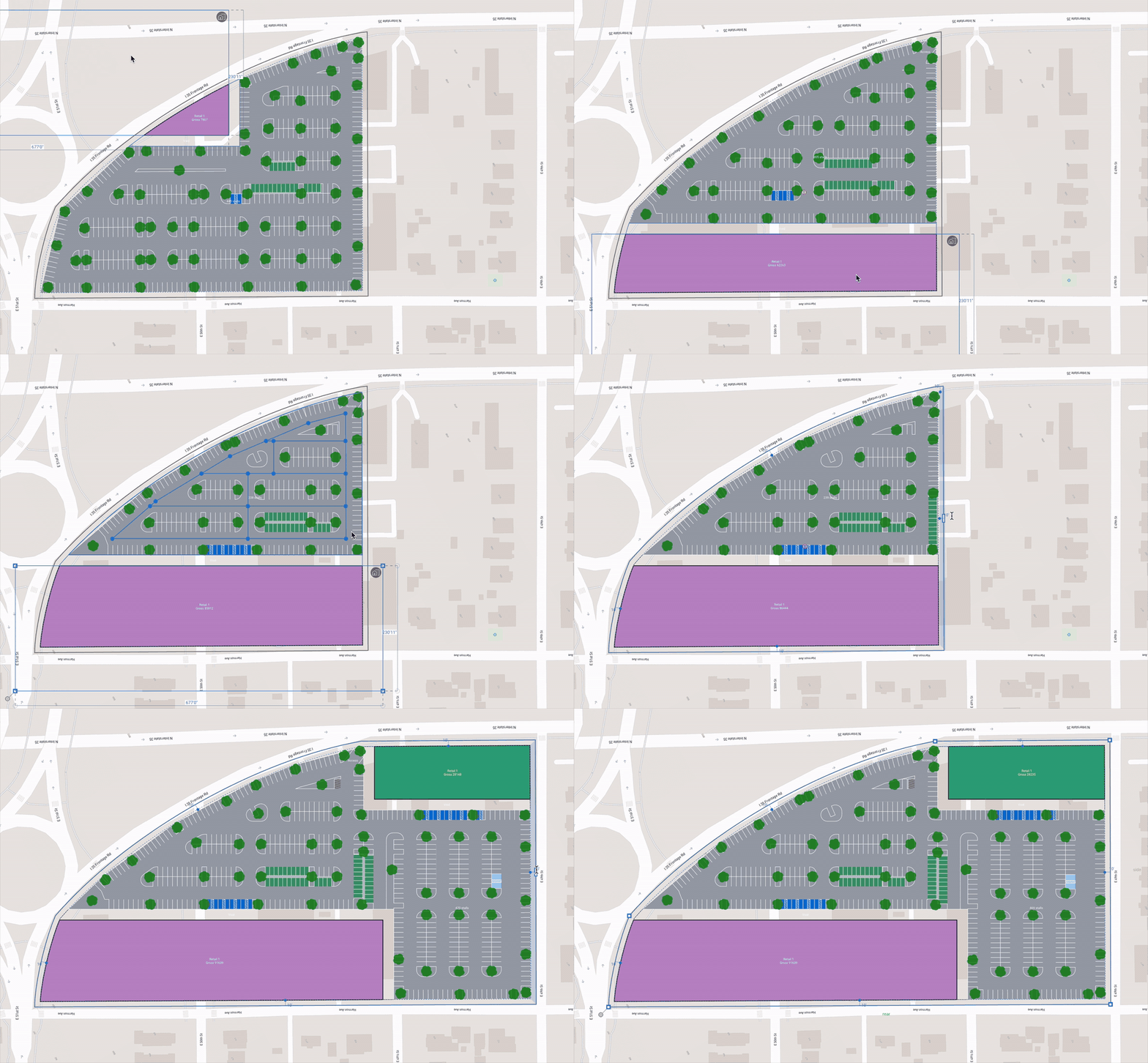
The same model carries the deal from first test to financing conversations:
- Generative design that produces many configurations and ranks them by financial metrics and site constraints
- A pro forma that runs on the solved geometry, so returns update with the plan
- Unlimited users and shareable deals, so lenders, capital partners, and land sellers see the same plan
Working on a grocery-anchored or redevelopment site? Book a quick demo for retail teams.
Source: Thesis Driven, The Deals Developers Are Analyzing Today, Q3 2026 Edition, based on TestFit platform data.