.svg)

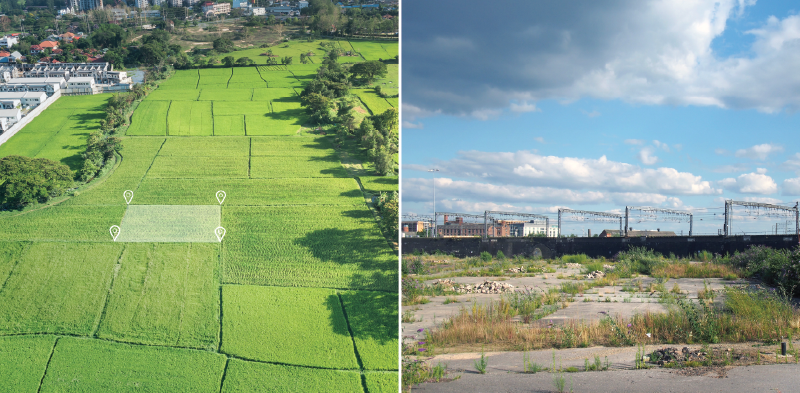
Most articles about greenfield and brownfield development stop at the definitions. Greenfield is raw land. Brownfield is a previously developed site, often with environmental baggage. The more useful question is what these two site types do to a project once you start laying it out and running the numbers. The real differences show up in your site plan, your pro forma, and the weeks you did not expect to lose.
Here is what changes when you move between the two.
Lot geometry does most of the damage on brownfield
A greenfield parcel is usually a relatively clean shape. Maybe there is a creek or a slope, but the boundary is predictable. You can place a building envelope and run drive aisles with reasonable freedom.
Brownfield sites rarely give you that. They sit in built-up areas, shaped by whatever was around them for the last fifty to a hundred years. You get awkward frontage, diagonal easements, setbacks tied to neighboring buildings, and sometimes a shared wall that forces the whole layout.
The effect is that your footprint is often dictated by the site before you start designing. On greenfield, you place the building to optimize yield. On brownfield, you place it wherever it fits and then figure out how to make the yield work. That is why the same unit count can cost very different amounts to lay out. A rectangular greenfield parcel lets you run a double-loaded corridor the full length of the building. A weird brownfield parcel forces bent or L-shaped buildings, which hurts efficiency and drives up cost per square foot.
The multifamily math is where this gets real
Multifamily is where the question gets most interesting, because the product can flex to either site, and the numbers diverge sharply.
Start with land. Suburban greenfield multifamily tends to run in the low five figures per door, sometimes under ten thousand on raw exurban parcels. Urban infill brownfield can easily run fifty thousand a door, and well past a hundred thousand in Boston, New York, Seattle, or San Francisco. That is before remediation.
The higher land cost comes back in rent. Infill brownfield multifamily typically commands meaningful premiums over comparable suburban greenfield product in the same metro, sometimes twenty to forty percent in strong markets. Walkability, transit access, and proximity to jobs are worth something.
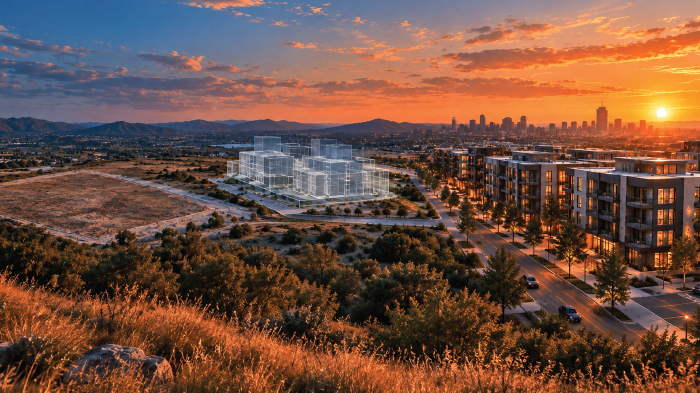
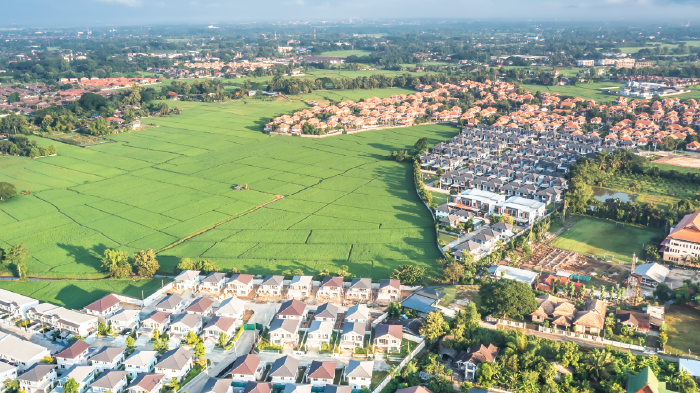
But density is where the two site types really split. Greenfield multifamily is almost always surface parked, usually 1.5 to 2.0 spaces per unit, which eats land. A typical garden-style project lands at 20 to 30 units per acre. Brownfield infill is where you wrap parking, podium over it, or build structured parking, which pushes density to 60 to 150 units per acre for mid-rise and high-rise product. That changes everything in the pro forma.
The catch is construction type. Greenfield garden is usually Type V wood frame: cheap, fast, familiar. Brownfield mid-rise is more often Type III over Type I podium, Type IV mass timber, or Type I concrete. All substantially more expensive per square foot. You are trading a cheaper building on cheaper land for a more expensive building on more expensive land, hoping rents and land efficiency make up the difference.
Sometimes they do. Sometimes they very much do not. The projects that work are usually the ones where someone ran the actual yield study early instead of trusting that a great location would bail out a bad layout. That is also where iteration matters: testing four or five layouts on the same parcel almost always reveals a better answer than committing to the first one.
TestFit is on the leading edge of utilizing AI to test multiple site layouts in minutes, which means the yield study can happen before the deal does, not after it is too late to walk away.
— Grant Brandenburg, Director of Regional Operations at Ware Malcomb
A real example: Atlantic Station
If you want to see every piece of this play out at once, look at Atlantic Station in Atlanta.
The site is 138 acres on the northwestern edge of Midtown, the former Atlantic Steel mill that operated from 1901 and closed at the end of 1998. The mill employed up to 4,000 people at its peak and left behind exactly the contamination you would expect from a century of steel production.
The cleanup was massive. Remediation required excavating 180,000 cubic yards of lead-contaminated soil, capping the remaining slag with at least two feet of clean fill, building a groundwater treatment system, and demolishing several asbestos-containing buildings. Roughly 150,000 cubic yards of mill foundation concrete had to be dealt with on site. Remediation alone cost $25 million in 2002.
The site also needed a new bridge. Cut off from Midtown by Interstates 75 and 85, the project required building the 17th Street Bridge, which nearly got blocked because Atlanta was out of compliance with Clean Air Act standards. EPA eventually signed off after analysis showed the compact redevelopment would reduce regional emissions versus pushing that density to the suburbs. Financing required $75 million in Tax Allocation Bonds and a negotiated Project XL agreement.
The payoff: a $3 billion project that today includes six million square feet of development, 3,000 residential units housing more than 5,000 residents, 7,000 employees, a luxury hotel, 11 acres of public parks, and an 8,000-space parking structure under the commercial core. The full case study is documented by the EPA Smart Growth program.
On a greenfield site, 3,000 multifamily units would need 100 to 150 acres of suburban garden product, zero remediation, no custom bridge, no tax allocation district, and probably five to seven years from land to last CO. Cost per unit would be dramatically lower.
But it also would not have produced Atlantic Station. You do not get a walkable mixed-use urban neighborhood connected to Midtown out of a greenfield site in Gwinnett County. You get garden apartments off an arterial. Both are fine businesses. They are just completely different businesses.
That is what the greenfield versus brownfield question is really asking. Not which is cheaper or faster. Which set of economics you are trying to build.
Infrastructure, environmental, and zoning all flip in unexpected ways
Greenfield sounds cheap because the land is cheap. But raw land is raw for a reason. You often have to bring utilities to the site, which can run into the millions, plus road improvements, turn lanes, and impact fees. Brownfield sites usually have utilities at or near the property line. So the cost story flips: greenfield gives you cheaper land and expensive infrastructure, brownfield gives you expensive land and cheaper infrastructure. Which wins depends on the specific site.
Environmental due diligence is the brownfield wildcard. Phase I on greenfield is usually a formality. On brownfield, Phase I almost always leads to Phase II, which means soil borings and lab testing. Remediation ranges from tens of thousands on a lightly impacted site to several million on anything with industrial history, or $25 million on a 138-acre steel mill. Timelines stretch six to twelve months at minimum. A financing wrinkle specific to multifamily: FHA does not allow remediation costs as a mortgagable expense, which makes brownfield affordable housing deals meaningfully harder to finance under standard HUD programs.
The good news is that early-stage screening has gotten dramatically better. Tools like TestFit’s data layers puts critical site intelligence directly into your feasibility workflow. Zoning, , flood zones, wetlands, soil data, and terrain all layer onto your site plan in one place, so you're not bouncing between GIS tools and zoning code before you've even started designing. The result is faster due diligence and fewer surprises when it matters most.

There is also a sustainability angle worth being honest about. Brownfield redevelopment reuses existing infrastructure, recycles already-disturbed land, and concentrates density inside built-up areas instead of pushing it out to farmland or forest. The EPA itself made this argument when it approved the 17th Street Bridge at Atlantic Station, finding that the compact infill project would produce lower regional emissions than the equivalent suburban greenfield alternative. That logic shows up in approval processes, in incentive programs, and increasingly in how investors and municipalities score projects.
Zoning moves in the opposite direction. Greenfield sites often need rezoning, which means public hearings, community engagement, and the risk of a council vote against you. Brownfield sites are usually already zoned for something intense, which can mean by-right development. The catch is that older zoning was written for older buildings. Setbacks, FAR, parking ratios, and height limits on urban brownfield sites can be oddly restrictive, and overlay districts and historic designations pile on.
So which is better?
Neither. That is the point.
Greenfield gives you layout freedom and lower land cost, at the price of infrastructure spending, entitlement risk, and the slog of getting utilities and approvals into an exurban area. Brownfield gives you existing infrastructure, established zoning, and often better locations, at the price of environmental risk, awkward geometry, and a due diligence process that can eat a year, or in Atlantic Station’s case, fifteen.
One more data point worth sitting with. According to the EPA Brownfields Program, a 2017 peer-reviewed study found that cleanup raised residential property values 5 to 15 percent within 1.29 miles of remediated sites, and a follow-up analysis estimated $29 to $97 million in additional local tax revenue per year from those same brownfields, two to seven times the federal cleanup contribution. When brownfield redevelopment works, it tends to work very well. The properties next door all get worth more too.
The best projects match the site type to the product. Suburban garden apartments make sense on greenfield. Urban mid-rise, podium multifamily, and adaptive reuse tend to work better on brownfield. The worst projects are the ones where someone fell in love with the land price or the location before checking whether the site could support what they wanted to build. The cure is simple, even when it is not easy. Run the site plan early, stress-test the cost assumptions, do the environmental work before the deal gets too far to kill cleanly, and pressure-test the zoning to make sure what you want to build is actually buildable. Software like TestFit is built for exactly this part of the process: instant site layouts that respect zoning, parking, and unit mix, so the question is not whether the building fits, but which configuration pencils best.
That is the real difference between greenfield and brownfield. The grass isn’t always greener. It is just a different set of problems, and the better question is which set you would rather solve.
Catch the Deal-Killers Early
Phase II surprises and awkward geometry are where brownfield deals die. Layer zoning, flood zones, wetlands, soils, and terrain onto your site plan before due diligence does it for you.