.svg)
.svg)
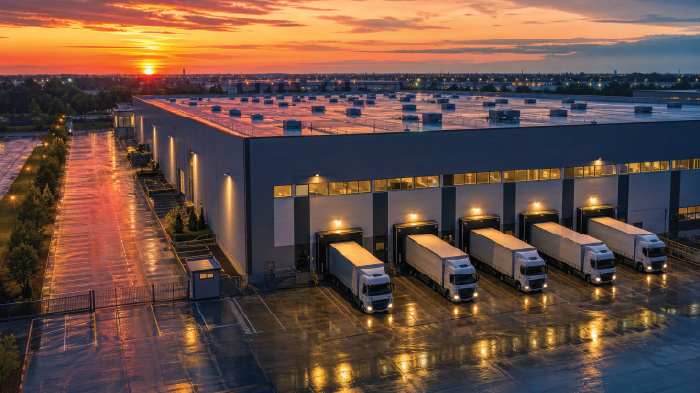

In April 2025, NFI plugged in a fleet of nearly 90 electric Class 8 trucks at a brand new charging depot inside a Prologis facility in Ontario, California. Volvo VNRs and Freightliner eCascadias, running drayage (the short-haul trucking that moves containers from a port to a nearby warehouse) between the Ports of LA, Long Beach, and the Inland Empire.
It is a great-looking depot. It is also the new industrial feasibility template, and most developers screening last-mile sites in 2026 don't realize their checklist is out of date. Last-mile sites are the smaller industrial parcels, typically 20 to 60 acres, that sit close to dense population centers and handle the final leg of delivery from regional distribution hubs to the customer.
Three years ago, evaluating a 40-acre parcel for a 500,000 square foot last-mile distribution center meant solving for five things: FAR, dock door count, truck court depth, parking ratio, and trailer storage. The site either worked or it didn't, based on geometry and zoning.
Today the screening question starts somewhere else entirely. It starts at the substation.
Why power moved to the front of the underwriting line
A working drayage depot needs several megawatts of power. That is small-town-scale load, dropped onto a single industrial parcel, and the utility has to deliver it before the building can open. Three years ago, a developer would have asked that question on the way to closing. Today it is the first question, because the answer increasingly is "not for a while."
The shift is institutional, not anecdotal. Prologis, a TestFit customer, now puts power availability alongside proximity to labor and ports as a top site selection factor in its 2026 outlook. The grid, not the entitlement process, has become the constraint.
The new screening order
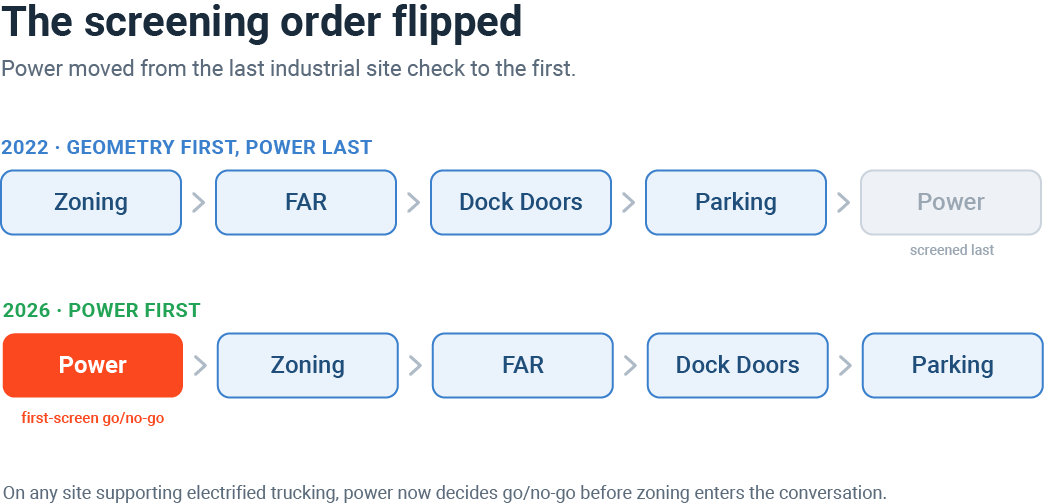
The order used to be zoning first, utilities last. Power was a yes-or-no question that got answered late in the process, and the answer was almost always yes.
That order has flipped. On any site that needs to support electrified trucking, power now drives the go/no-go decision before zoning enters the conversation.
Here's why. PG&E's own published energization timelines, set under California's 2024 Powering Up Californians Act, put the average new commercial service line at 182 days. A new substation, the kind a large multi-fleet hub often requires, carries a maximum timeline of 3,242 days. That is just under nine years.
Industry guidance lines up with the utility's own data. Utility upgrade lead time is consistently cited as the number one reason fleet electrification plans stall before a truck is even ordered. If power is going to drive 12 to 24 months of schedule on the cleanest deals, and multiple years on the harder ones, it has to be the first thing a developer screens. Not the last.
The new lot-fit problem
Even when the power is available, the site has to absorb the charging infrastructure without compromising operations.
Look at what's happening in the Inland Empire. EV Realty opened its San Bernardino hub in April 2026, designed to serve more than 200 medium- and heavy-duty trucks a day, sitting two miles from the Intermodal Facility and adjacent to 60 million square feet of industrial space. The site exists because the megawatts exist. EV Realty calls its model Powered Properties, and the name is the giveaway. Power is the property.
Prologis Mobility tells the same story from a different angle. Its prefabricated modular charging platform, launched in Vernon in 2025, arrives assembled and can operate ahead of a permanent utility connection. The infrastructure is designed to be deployed in markets where utility capacity lags vehicle availability, because waiting for the grid is no longer an option.
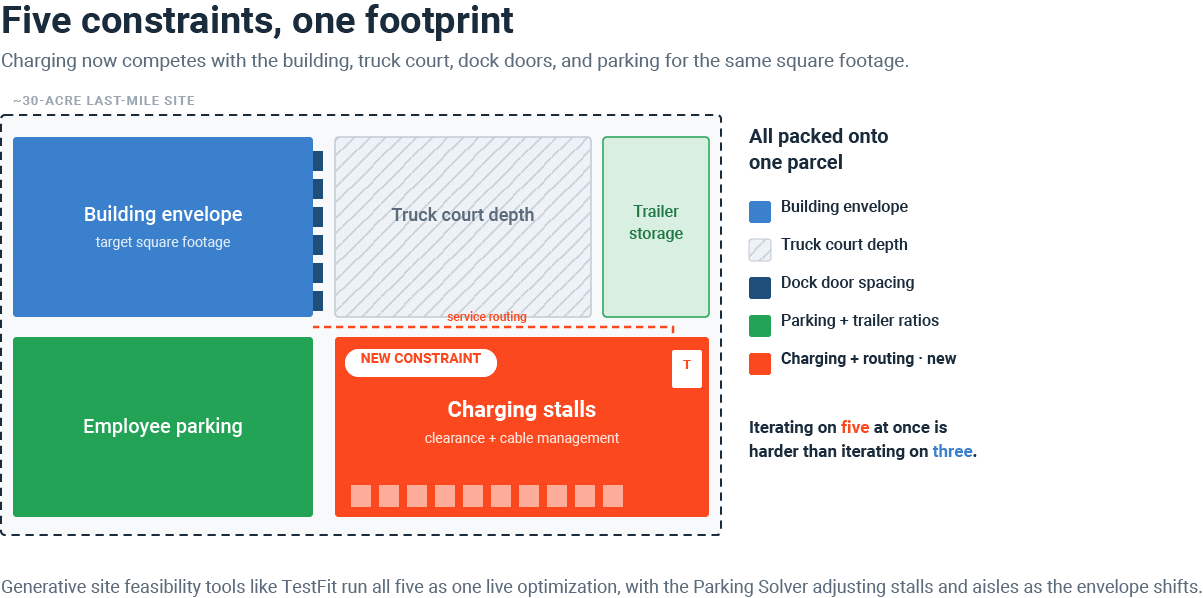
Whatever the operating model, the lot-fit math has changed. A developer screening a 30-acre last-mile site now has to solve for, all at once:
- A building envelope that hits the target square footage
- A truck court deep enough for trailer maneuvers
- Dock doors at industry-standard spacing
- Employee and trailer parking ratios
- Dozens of charging stalls, each with clearance requirements, electrical service routing, and cable management back to the transformer
Every one of those constraints competes with the others for the same square footage. Iterating on five constraints at once is harder than iterating on three. That's the new lot-fit problem.
The sites that work in 2026 are not the sites that worked in 2022
Three patterns are emerging in where the deals are getting done.
Freight corridor proximity is mandatory. Every hub coming online in California is clustered near the Ports of LA and Long Beach or the major north-south interstates. The federal National Zero-Emission Freight Corridor Strategy designated LA County as a Phase 1 priority in 2024, and the capital is concentrating accordingly.
Substation distance is the new highway visibility. The further a site sits from a substation with available capacity, the longer the utility upgrade timeline gets and the more the deal slips. EV Realty's recent Stockton acquisition was explicitly described as sitting in a power-constrained region of Northern California. The site won not because of its building, but because grid-ready land in that market is scarce.
Shared infrastructure is creating a new asset class. Multi-tenant Powered Properties aggregate fleets onto shared private infrastructure, which lowers per-truck cost and lets fleets that can't afford their own depot still electrify. For developers, that means the site doesn't need to fit a single tenant's fleet profile. It needs to fit a market's worth of charging demand.
What this means for site feasibility teams
The teams winning last-mile and drayage-adjacent deals in 2026 aren't winning on building design. The building is mostly solved. They're winning on screening velocity: the ability to evaluate parcels against the new feasibility math fast enough to make offers while the site is still available.
Three practical implications for anyone screening industrial sites right now:
- Add utility interconnection to your initial screen. Pull substation maps. Talk to the utility before the broker tour. Treat one to two years as the floor, not the ceiling, on power timeline.
- Run dock doors, truck courts, and charging stalls as a single optimization, not a sequence. If you can't iterate on all three at once during feasibility, you'll discover the lot-fit problem after the contract goes hard.
- Underwrite the parcel for the market's electrification curve, not the first tenant's needs. Sites that can scale charging capacity over time will command different rent.
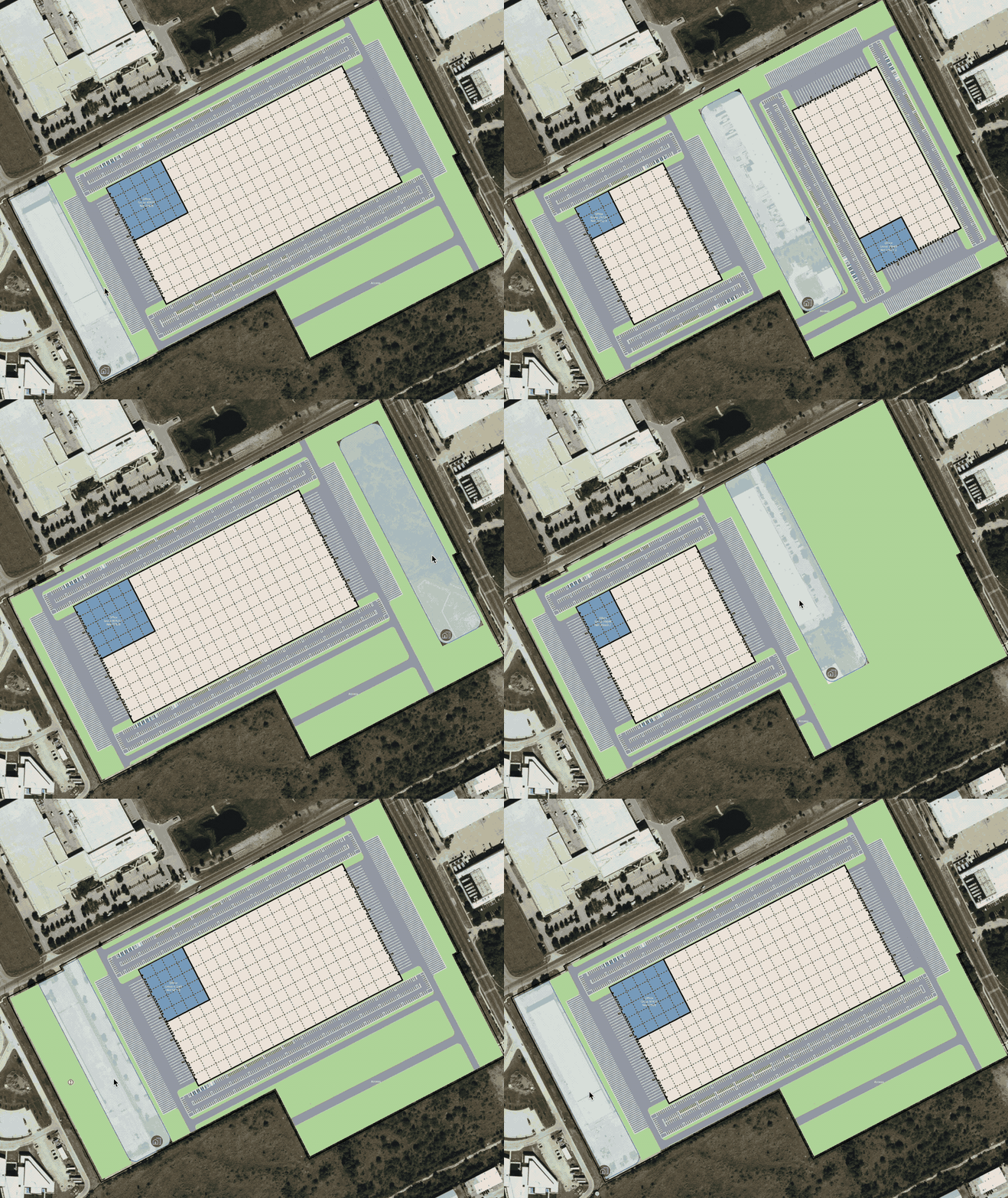
Generative site feasibility tools exist precisely because this kind of multi-constraint screening can't be solved manually at the pace deals close. TestFit's industrial configurator runs dock doors, truck courts, trailer storage, and parking as a single live optimization, with the parking configurator handling stall counts, drive aisles, and ADA requirements as the building envelope shifts. Teams that can run those tradeoffs in an afternoon are going to outscreen the ones who can't.
The new feasibility velocity bar
Fleet electrification has rewritten the underwriting calculus on every last-mile and drayage-adjacent site in the country. Power moved from a late-stage confirmation to a first-screen go/no-go. Charging footprint moved from a checkbox to a constraint that competes with dock doors and truck courts for the same square footage.
The parcels that worked in 2022 still work as buildings. They don't all work as Powered Properties. The developers who figure out the difference, and figure it out fast, are the ones whose pipelines pencil in 2026.
Solve all your constraints at once
Dock doors, truck courts, trailer storage, parking, and charging stalls now compete for the same square footage. Run them as a single live optimization so you can screen Powered Properties as fast as deals close.