.svg)


Capital is moving back into commercial real estate in 2026, but selectively. Lenders are easing standards, third-quarter sales volume rose more than 40 percent year over year, and forecasters are calling for a 15 to 20 percent rebound in transaction volume. What hasn't changed is the math. Construction costs remain elevated, and persistent barriers, including interest rates and tariffs, continue to slow deal-making. Every site comes with a longer list of constraints than it used to. That puts more weight than ever on a single decision developers have always had to make. Does this deal pencil?
What does it mean for a deal to pencil?
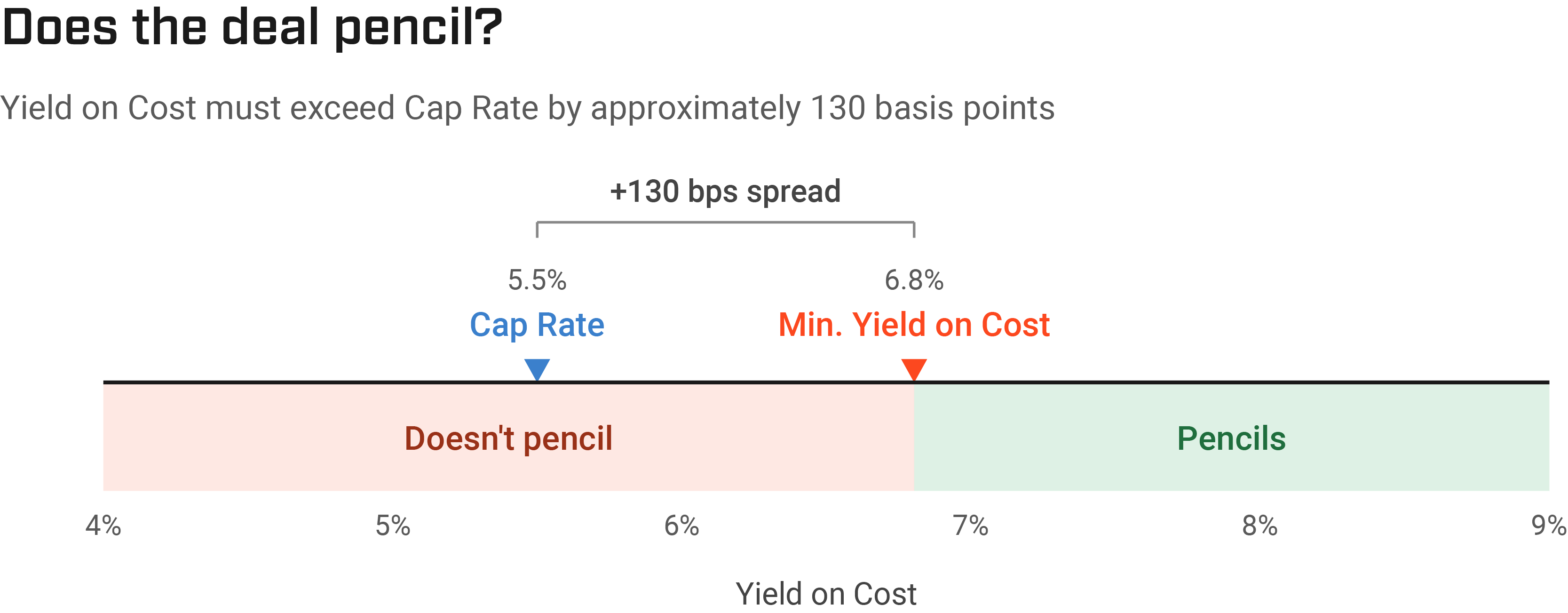
"Penciling" is shorthand for whether a development project's projected returns are high enough to justify building it. The math is straightforward in theory. A developer compares the yield on cost, defined as net operating income divided by total project cost, against the cap rate they would pay to buy a comparable existing building. If that spread isn't wide enough to justify the development risk over acquiring an existing asset, the deal doesn't pencil. As a working benchmark, capital partners often look for yield on cost roughly 130 basis points above the terminal cap rate, with LP equity in development typically targeting 15 to 20 percent IRR.
In practice, the math is anything but simple. Yield on cost depends on rent assumptions, parking ratios, unit mix, setback requirements, construction cost inflation, and the buildable area a site actually supports under its zoning. Change any one of those inputs, and the answer can flip.
Why it is harder than it should be in 2026
Two things make penciling harder than it sounds. The first is that the inputs keep moving. Construction costs remain volatile, lending standards are easing but unevenly, with just 9 percent of banks tightening as of mid-2025 compared with more than 30 percent in early 2024, and several markets are absorbing oversupply, particularly in Sun Belt multifamily, where aggressive underwriting persists despite elevated vacancy. Underwriting that worked last quarter may not work this one.
The second problem is sequencing. The traditional path to a yes runs through weeks of design work, civil engineering review, and pro forma modeling, much of it paid for before anyone knows if the numbers will land. Developers face significant sunk costs before deal approval, paying for feasibility studies, legal fees, zoning applications, and architectural designs before receiving municipal approval. Spend all that, then discover that a parking minimum or a setback eats enough yield to kill the deal, and the cost is more than wasted fees. It is slower deal flow, more deals declined out of caution, and good land lost to faster competitors.
Where the workflow is changing
Site planning AI tools like TestFit are changing how teams answer the penciling question. Instead of testing whether a deal pencils after weeks of design, developers can validate it against an actual layout in the same session they are evaluating the site. Zoning, density, parking ratios, unit mix, and conceptual cost run in parallel, and the pro forma updates as the site plan changes. If a setback eats yield, the user sees it immediately. If a unit mix shift recovers the deal, the user sees that too.
The 2026 TestFit ROI Report, based on a survey of 1,341 customers, found that 70 percent of developers are finding higher yield or density in their deals using TestFit, and developers are making go/no-go decisions 1.6x faster on average. Hannah Moell, Business Developer at BSB Design, describes what that compression looks like inside an actual practice:
"We went from 2 weeks to as little as 2 days in site planning. Our team can now complete each land plan in just 1 day, allowing us to immediately show developers whether a project 'pencils' or not."
Faster doesn't just mean answering the same question sooner. It means asking the question earlier, on more sites, before any design fees have been spent, and changing the answer through iteration when the first pass doesn't pencil.

What this means for developers in this market
For a developer working in 2026's selective capital environment, the practical impact is in where time and money go. Hours that used to be spent waiting for a design pass to confirm or kill a deal can be redirected into evaluating more sites, pressure-testing more scenarios, and bringing capital partners higher-conviction underwriting earlier in the conversation. Deals that do pencil reach the investment committee with the actual layout backing the numbers. In a market where sentiment is improving but the catalyst is data-driven conviction rather than easy money, that's the edge.
What it means for architects
Architects sit on the other side of the same question. They don't own the penciling decision, but they often produce the work that informs it. Increasingly, they're being asked to do it faster, on tighter fees, and as a precondition for winning the larger design work that follows. The firms gaining ground in 2026 are the ones turning feasibility from a cost center into a relationship-builder.
The ROI Report finds that 61 percent of architects report winning more projects with TestFit. The mechanism is simple: when an architect can answer the penciling question during a developer's first walkthrough of a site, they stop competing on hourly rates and start competing on insight. The firm that gets a credible answer back first is the firm that wins the design work behind it.

What it means for penciling
For developers, the shift is about decision velocity and yield. For architects, it's about relationship leverage and win rate. For penciling itself, the change is more fundamental.
When a team can test zoning, unit mixes, parking ratios, and conceptual cost against a real layout in minutes, penciling stops being a verdict and starts being a conversation. A site that doesn't pencil at first pass might pencil with a different unit mix. A configuration that pencils on paper might fall apart when the parking eats the buildable area. Both answers come back fast enough to matter.
That's the shift TestFit is built for: validating pro formas against actual layouts, generating automatic takeoffs for parking and infrastructure, and comparing design schemes side by side so teams can find the version that works before anyone commits to a path. Penciling stops being the question that gets answered at the end of the feasibility process. It becomes the question that gets answered at the start.
See the Numbers Behind Faster Yes/No
1,341 customers told us what changes when penciling moves to the front of the deal. Get the full benchmark data on yield, decision speed, and win rates.