
Real estate moves fast, and the teams that win are the ones who can answer the hard questions first. Does it pencil? What does the zoning actually allow? How many units can we fit? For ten years, TestFit has helped architects, developers, planners, and brokers answer those questions faster and with more confidence. Here are the stories of ten customers who use TestFit to optimize feasibility and gain an edge over their competitors:
RBA Architects
RBA Architects came to TestFit as early adopters with a portfolio spanning 3,500 single-family homes and 5,000 multi-family units. Before TestFit, a single site plan took 20 to 30 hours in AutoCAD, plus another 30 to 40 hours of 3D massing in Revit. TestFit collapsed that to 4 to 6 hours, and unlocked 7 times the number of design iterations in the same window.
That speed translated directly into wins. Across nearly 100 projects in TestFit, RBA has generated over $750K in fees. More than a productivity tool, TestFit flipped their entire design process: instead of civil engineers leading with parking layouts, RBA now drives site planning from the inside out, putting architects back in the driver's seat from day one.

In our client meetings, we’re able to take the lead as we have the capability to modify designs in real-time. Countless times in meetings, I simply overlay a quick sketch of the property line and present a tangible, feasible design idea on the spot.
— Tom Retnauer, President
Read the full story: How RBA Architects Won $750K+ in Fees with TestFit
Ware Malcomb
Ware Malcomb is a 950-person global design firm with 28 offices across the Americas. As they pushed into the multi-family market, site feasibility studies became a key business development tool, but the non-billable hours were adding up fast. The team ran a side-by-side test: one person doing a site plan manually, another in TestFit. TestFit took a third of the time. They were sold.
In the first year alone, the firm saved over $200,000 in non-billable hours, and now uses TestFit as the connective tissue across offices to deliver a consistent level of service to corporate developer clients nationwide. With co-authoring, instant 2D-to-3D visualization, and real-time calculations replacing hours of manual math, Ware Malcomb can walk into any underwriting conversation as a trusted advisor, ready to show their clients exactly what a site can do.

The volume of sites that we’re vetting for clients these days would be a much bigger sunken cost, whereas now we can do this at very little cost to ourselves because it only takes 1/3 of the time to do a site plan in TestFit.
— Grant Brandenburg, Director of Regional Operations
Read the full story: How Ware Malcomb Saved $200k-$300k in Non-Billable Hours with TestFit
Upper Merion Township
Upper Merion Township is a regional economic powerhouse, home to King of Prussia Mall and the county's largest office park, but Jarrett Lash runs planning as a team of one. With virtually no undeveloped land left and post-pandemic pressure on the tax base, he needed to make fast, data-backed decisions about zoning and redevelopment. TestFit became his force multiplier.
From density comparisons to stormwater trade-offs to parking lot reimagination, Jarrett uses TestFit to model what zoning actually builds, in real time, in public meetings, with elected officials watching. It has turned policy from an abstract exercise into something visual, testable, and tied to fiscal reality.
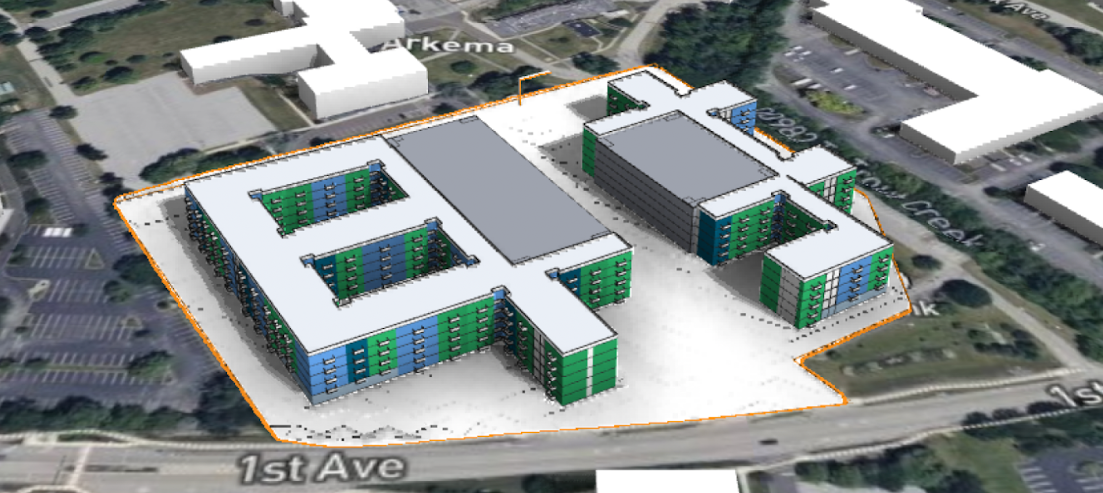
I'm a planning team of one, so I need force multipliers. What used to take a day in SketchUp, I can now do in 15 minutes live with elected officials in public meetings to show them the changes in real time.
— Jarrett Lash, Township Planner
Read the full story: How Upper Merion Township Uses TestFit to Align Zoning Policy with Development
Are you a city looking to use TestFit? Get TestFit Data Maps FREE for 1 year
CPA Architecture
CPA Architecture has built their entire feasibility workflow around TestFit since 2018. Coming from a development background, principal Christiano Pereira approaches every project with a pro forma lens, and TestFit lets his 15-person firm punch well above its weight. What used to mean trace paper, CAD overlays, and manually counted unit blocks now happens in real time, with instant financial feedback. The result: 3x more feasibility work delivered with the same team, and $150K to $200K in annual operational savings.
But the bigger win is what it saves their clients. By combining TestFit's speed with deep zoning knowledge and in-house financial modeling, CPA helps developers avoid costly mistakes before a dollar is spent on design, turning feasibility into a competitive advantage that wins repeat business.

The savings of using TestFit are tremendous. Our junior designers are designing over 1,000 units with only 1 year of experience in multi-family, while learning the impact of pro forma in their design. That wouldn’t be possible without TestFit.
— Christiano Pereira, Principal
Read the full story: How CPA Architecture Saves $200K in OpEx with TestFit
BSB Design
Before TestFit, BSB Design's feasibility studies took up to two weeks, with land plans alone requiring four days in CAD. TestFit collapsed that to a single day, a 75% reduction in cycle time that lets the firm give developers fast, confident answers on whether a site pencils.
Beyond speed, TestFit changed how BSB engages clients. Instead of lengthy email chains, the team now generates 8 to 10 design options live in meetings, with clients adjusting unit mixes and parking configurations in real time. The hours saved get reinvested into staff training and AI innovation, keeping BSB future-ready while delivering faster, better feasibility work.
We went from 2 weeks to as little as 2 days in site planning. Our team can now complete each land plan in just 1 day, allowing us to immediately show developers whether a project ‘pencils’ or not.
— Hannah Moell, Business Developer - Solutions Collection/Market Researcher
Read the full story: How Mid-Sized BSB Design Gets 4x Faster in Land Planning with TestFit
AC Martin
AC Martin is one of California's oldest architecture firms, founded in 1906, and still pushing the pace. Before TestFit, their multi-family feasibility studies started from a blank slate every time, with manual drawings in Revit, SketchUp, or AutoCAD and unit counts tallied in spreadsheets. A typical week might yield two or three schemes. With TestFit, principal Sami Khoury runs that same process four times over, directly inside client calls.
Rather than taking notes for later analysis, Sami now inputs unit targets and site requirements into TestFit live on the call, generating multiple scheme options in 15 to 20 minutes while clients watch the metrics update in real time. The firm has also extended the workflow by feeding TestFit massing models into AI rendering tools like Midjourney and Stable Diffusion, turning early feasibility work into investor-ready visuals at a fraction of the traditional cost.

Gradually, clients who experienced our initial TestFit session, where we provided them with the feedback they wanted in real-time, began specifically requesting a TestFit exercise first when they returned, before investing in the necessary manual processes of detailed and robust yield and feasibility studies.
— Sami Khoury, AIA, Principal
Read the full story: How AC Martin 4x'd Multi-family Design Options with TestFit
Motif Architects
Motif is a two-person, fully virtual firm run by husband-and-wife partners Casey and Rachel Johnson. When a developer client tasked them with delivering a mixed-use site study in just three weeks, they were competing against firms with entire dedicated planning teams. TestFit leveled the playing field. Casey onboarded the same week he discovered it on LinkedIn, and the study went from concept to completion on time and within budget.
Without TestFit, Motif estimated they would have burned through twice their allotted project fee. Instead, they delivered a compelling study, hit their target fee, and built client trust by iterating on design options live in meetings. For a two-person shop juggling five or six projects at once, that kind of efficiency is not a nice-to-have. It is how they compete.
We literally brought our laptop to the client and were moving around TestFit live on the screen. They were shocked—seeing opportunities and constraints unfold in real-time.
— Casey Johnson, Project Manager & Partner
Read the full story: How Motif Architects Compete at Scale with TestFit
Prince Property Group
Brian Prince spent years in large-scale multifamily development watching feasibility studies take three to four weeks to come back from preconstruction teams. When his firm hesitated to adopt TestFit, he bought a license on his own and ran a 10-minute site analysis that surprised everyone in the room. That moment set the course for what came next: starting his own firm.
Prince Property Group runs lean by design. Rather than building out a large team, Brian uses TestFit to do what once required one, handling deal evaluation, unit mix optimization, quantity takeoffs, and pro forma modeling as a team of one. He describes the model as a "Rubik's Cube" he can solve before handing off to architects, so the projects they spend time on are the ones that will actually get built.

As a novice person who doesn’t know design, I feel less intimated in the feasibility process using TestFit. We can all do more with this new tool and technology.
— Brian Prince, President & CEO
Read the full story: How TestFit Inspires Prince Property Group to Start a New Development Firm
Trinity Commercial Group
For Trinity Commercial Group, a Southwest Florida brokerage, speed is everything. A site plan that once took 30 days and cost up to $2,500 now gets done in a matter of hours. That shift has fundamentally changed how Dan O'Berski and his team work, letting them generate buildable feasibility studies the same day a deal comes in and move faster than competing brokers.
TCG uses TestFit not just to save time internally, but to tell visual stories that get everyone aligned. From helping buyers and sellers understand a site's potential to creating line-of-sight and massing studies that ease city approvals, TestFit has become the connective tissue across every stakeholder in a deal.

I sat down one weekend and did a 65-acre development site plan in 3-4 hours and later this complicated mixed use project in 1.5 hours. Before, it would take at least a week of back-and-forth revisions and cost us thousands of dollars.
— Dan O'Berski, Partner
Cascadia Partners
Cascadia Partners works with city governments across the Pacific Northwest to evaluate zoning codes and unlock the potential of publicly owned land. Before TestFit, building out site alternatives meant SketchUp models at roughly $300 each and up to 20 billable hours per analysis. TestFit replaced that with real-time modeling, letting the team generate 3 times the iterations within the same budget and include more alternatives in every RFP response.
The impact goes beyond efficiency. In work for the City of Lebanon, Oregon, Cascadia used TestFit to show how a zoning code adjustment could reduce the minimum feasible price of housing by 28% while fitting twice as many units per acre. By translating zoning rules into what is actually likely to get built, Cascadia helps cities and developers find common ground, turning an often adversarial relationship into a shared path toward more housing.

With TestFit, we can produce 2-3 times more alternative models on a fixed budget. With a $10,000 budget for building modeling, we could create 37 models, whereas before we could only create 15.
— Jamin Kimmell, Partner
Read the full story: How Cascadia Partners Uses TestFit to Demystify Zoning and Address the Housing Crisis
Built Together
TestFit is built alongside the people who use it. Every customer in this collection has shaped the platform in some way, through the problems they brought, the workflows they invented, and the questions they kept asking. That relationship doesn't stop at ten years. New customers are finding TestFit every day and doing things with it we haven't seen before. That's what keeps the work interesting, and what makes the next ten years worth looking forward to.
Thanks to all of our valued customers and the way they continue to shape TestFit and the industry.
Here’s to 10 more.