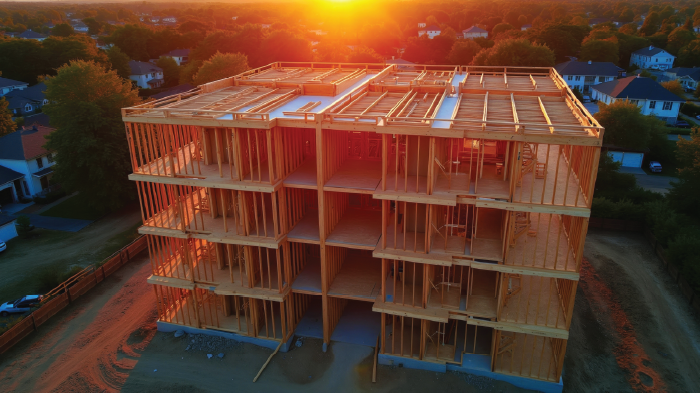

Fewer developers are testing dense multifamily sites. The ones who are testing them are thinking bigger.
According to TestFit data in the Q3 2026 edition of The Deals Developers Are Analyzing Today, the median higher-density multifamily project rose from 174 units in Q2 2026 to 213 units in Q3, a 22% jump in a single quarter. That happened while overall dense multifamily activity fell.
The drop in activity is real. Higher-density multifamily runs fell from a peak of 25,022 in Q1 2026 to 15,195 in Q3, a 39% decline in six months. Dense multifamily also slipped to 45.2% of residential feasibility activity, the first time it has fallen below half.
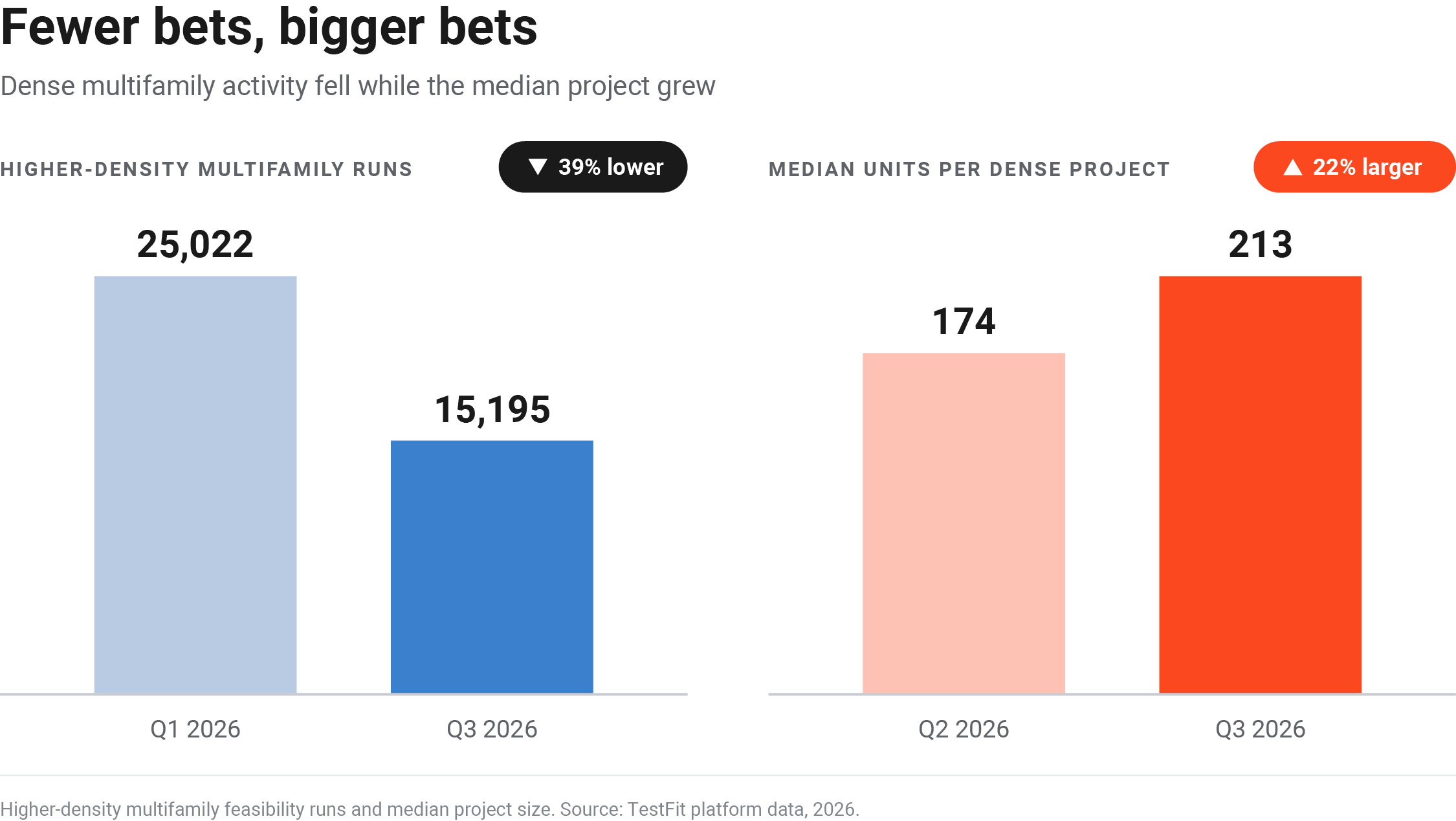
Thesis Driven describes the pattern as fewer, larger bets. Developers are concentrating on the sites that justify the time, cost, and risk of a dense project today.
In other words, the thousands of small infill tests that once filled the pipeline are thinning out. What remains is a smaller set of larger, more deliberate pursuits. For developers and architects, that changes how multifamily development site selection should work.
Why scale wins right now
In a market with high construction costs and soft rents in many metros, size helps a project pencil in several ways:
- Fixed costs spread further. Entitlements, design, site work, and amenities cost roughly the same whether a project has 150 units or 250. More units means less cost per unit.
- Better financing terms. Larger projects can attract institutional capital and lenders who prefer bigger loans.
- More efficient buildings. Larger floor plates and longer corridors often improve the ratio of leasable area to gross area.
- Stronger amenity packages. More units can support the pools, fitness centers, and coworking spaces that help a building compete during lease-up.
- Lower operating cost per unit. Staffing, management, and maintenance contracts also spread across more doors.
The logic is simple. When rent growth is flat, a developer cannot count on the top line to rescue a thin deal. The lever left is cost per unit, and scale is one of the most reliable ways to pull it down.
That does not mean bigger is always better. A project that outgrows its market can stall in lease-up. The goal is to find the largest unit count the site, the zoning, and the submarket can all support.
A worked example: 174 units vs. 213 units
To see how scale changes the math, consider a hypothetical 4-acre site. The numbers below are illustrative, built on simple stated assumptions and the report's medians.
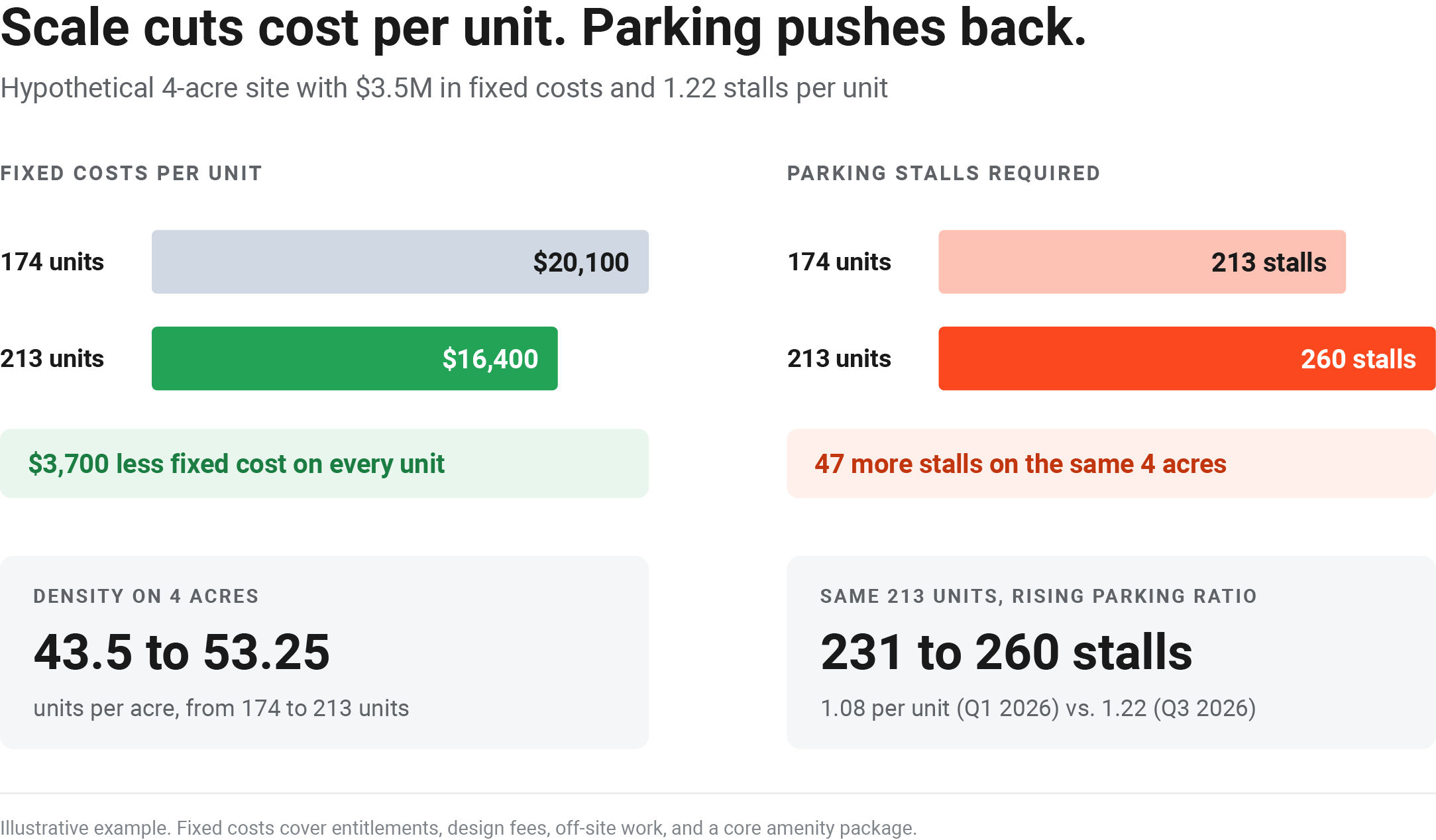
Assume the project carries $3.5 million in costs that do not change much with unit count: entitlements, design fees, off-site work, and a core amenity package. Assume a median parking ratio of 1.22 stalls per unit, the Q3 2026 figure from the report.
- Density on 4 acres: 43.5 units per acre at 174 units, 53.25 units per acre at 213 units
- Fixed costs per unit ($3.5M): about $20,100 at 174 units, about $16,400 at 213 units
- Stalls at 1.22 per unit: 213 at 174 units, 260 at 213 units
At 213 units, every unit carries about $3,700 less in fixed cost. That gap can be the difference between a deal that clears a lender's hurdle and one that does not.
The parking line tells the other side of the story. Adding 39 units adds 47 stalls. If those stalls must be surface parking, they compete with the buildings for the same 4 acres. If they move into a structure, cost per stall rises fast.
Parking ratios matter here too. At the Q1 2026 median of 1.08 stalls per unit, the 213-unit plan would need 231 stalls. At today's 1.22, it needs 260. That is 29 more stalls on the same site, with no added revenue.
The takeaway: scale helps, but only if the site can physically hold it. That is why the screening questions below matter so much.
What pencil-ready sites have in common
Scale alone is not enough. The deals moving forward tend to share a few traits:
- Assembled land. Sites where the hard work of combining parcels is already done.
- Cleared entitlements. Zoning that already allows the density, or approvals already in hand.
- Enough acreage. Room for the unit count, parking, and open space the market expects.
- Fewer site surprises. Known flood zones, utilities, easements, and access, so the design does not change late.
These sites are worth a developer's time because they remove the biggest sources of risk before design starts.
Each trait shortens the path from a promising test fit to a financeable deal. Assembled land removes negotiation risk with multiple land sellers. Cleared entitlements remove months of hearings. Enough acreage keeps parking from eating the unit count.
For architects, these traits also signal which client pursuits are likely to move into real design work. A site with known constraints produces a scheme that survives contact with the civil engineer and the planning department.
Bigger deals and longer evaluations go together
This trend connects directly to another finding in the report: high-density multifamily deals now take an average of 106 days to evaluate, up from 21. Larger projects take longer to analyze, and each pursuit now ties up more of an acquisitions team's time.
The report adds useful detail. Mean active days, the days someone actually worked in the file, rose from about 3 to 7. Most of the added time is gaps between work sessions, not more hours per session.
That pattern points to waiting. Teams are waiting on capital partners, lender feedback, updated cost estimates, and land seller responses. Each pause stretches the calendar while the deal sits open.
That makes site screening more important than ever. When every pursuit costs more, the value of saying no early, and saying yes with confidence, goes up.
A fast, accurate first pass protects the team's calendar. It lets acquisitions spend those 100 days on the two or three sites that deserve them, instead of spreading attention across ten that never had a chance.
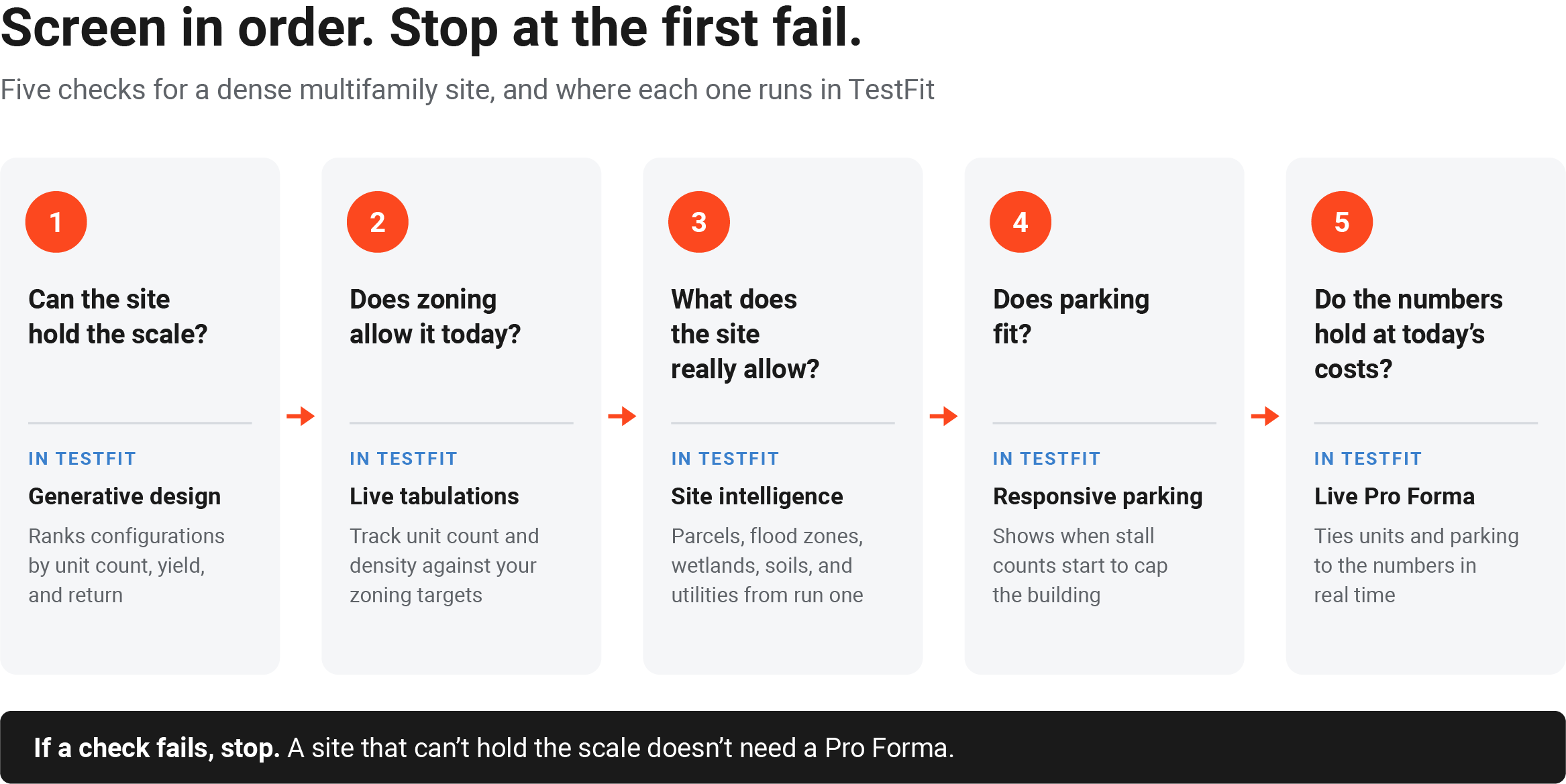
A screening checklist for your next multifamily site
Before committing months to a dense multifamily deal, check:
- Can the site hold the scale? Test unit counts at several densities to find the point where the deal works.
- Does zoning allow it today? Confirm height, FAR, setbacks, and parking requirements, and note any density bonus paths.
- What does the site really allow? Map flood zones, wetlands, easements, and utility locations before design starts.
- Does parking fit? At today's rising ratios, parking often caps unit count before height does.
- Do the numbers hold at today's costs? Run the pro forma with current rents and construction pricing, not last year's.
A site that clears all five is a site worth the 100 days.
A practical tip: run these checks in order, and stop as soon as one fails. A site that cannot hold the scale does not need a pro forma. A site in a flood zone may need a different typology before the numbers are worth running.
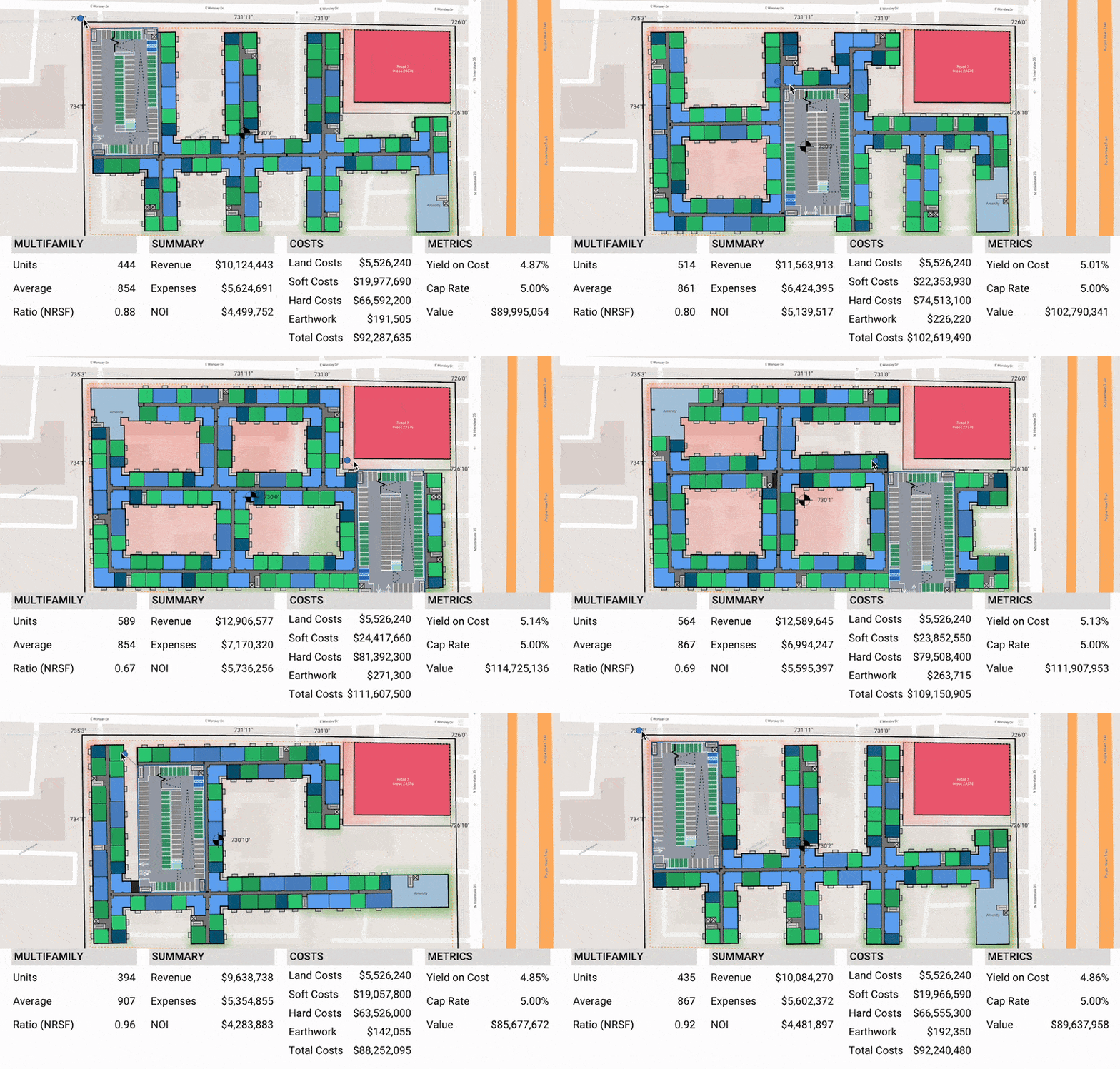
It also helps to test more than one building type on the same parcel. A garden plan, a wrap, and a podium can land at very different unit counts and costs. Comparing them side by side shows which form unlocks the scale the deal needs.
Frequently asked questions
Why are multifamily projects getting larger?
High construction costs and soft rents make thin deals hard to finance. Larger projects spread fixed costs over more units and can attract institutional capital. TestFit data shows the median dense project rose from 174 to 213 units in one quarter.
How long does it take to evaluate a dense multifamily deal?
According to the Q3 2026 report, the mean evaluation window is now 106 days, up from 21 days in Q2 2025. Most of that added time is gaps between work sessions, which suggests teams are waiting on capital, costs, and approvals.
What makes a multifamily site worth pursuing?
The strongest sites have assembled land, zoning that allows the density, enough acreage for units and parking, and known site conditions. Those traits remove the biggest risks before design begins.
Does parking limit how big a project can get?
Often, yes. The median parking ratio for dense multifamily rose from 1.08 to 1.22 stalls per unit between Q1 and Q3 2026. On a fixed site, more stalls per unit can cap the unit count before height limits do.
Why TestFit is the authority on multifamily feasibility
The shift to fewer, bigger bets is visible because developers screen their multifamily sites in TestFit. More than 100,000 site analyses ran on the platform last quarter, and Thesis Driven has tracked that activity with us for nine consecutive quarters. That gives TestFit an unmatched view of how developers are sizing deals right now.
For more than a decade, TestFit has been the feasibility platform developers and architects use to test sites before they commit. That history is why the data carries weight. It reflects real decisions on real parcels, quarter after quarter.
The results show up in daily work too. According to TestFit's 2026 ROI report, survey respondents cut feasibility time by 80%, from 11 to 25 hours per study to 0 to 5. Developers save 18 hours per feasibility study and create 5x more design iterations per site. Respondents also make go/no-go decisions 1.5x faster.
Customer teams see the same leverage. Trinity Commercial Group cut site planning from 30 days to a week. Prince Property Group can create 12 schemes in one sitting and sizes up a site in 10 minutes. Sami Khoury, a principal at AC Martin, averages at least one feasibility study a day for clients.
It also makes TestFit the best place to screen your own sites:
- Site intelligence with parcels, flood zones, wetlands, soils, and utilities, so you see the site's real limits from the first run
- Multifamily typologies from garden to wrap to podium, tested on the same parcel
- Generative design that explores and ranks configurations by unit count, yield, and return
- Responsive parking that shows when stall counts start to cap the building
- Live tabulations and pro forma that tie unit count and parking to the numbers in real time
TestFit calculates, it does not guess. When every deal is a bigger bet, you need to know what the land is worth before you commit to it.
That is the real advantage in a market of fewer, larger pursuits. The teams that screen faster get to the right site first, and they arrive at the 100-day evaluation with a scheme that already holds up. With unlimited users and shareable deals, acquisitions, design, and capital partners all review the same scheme.
Screen your next multifamily site in minutes. Book a quick demo focused on site screening.
Source: Thesis Driven, The Deals Developers Are Analyzing Today, Q3 2026 Edition, based on TestFit platform data.