.svg)
.svg)


What Is Permitting? The Hidden Deal-Killer Most Developers Underprice
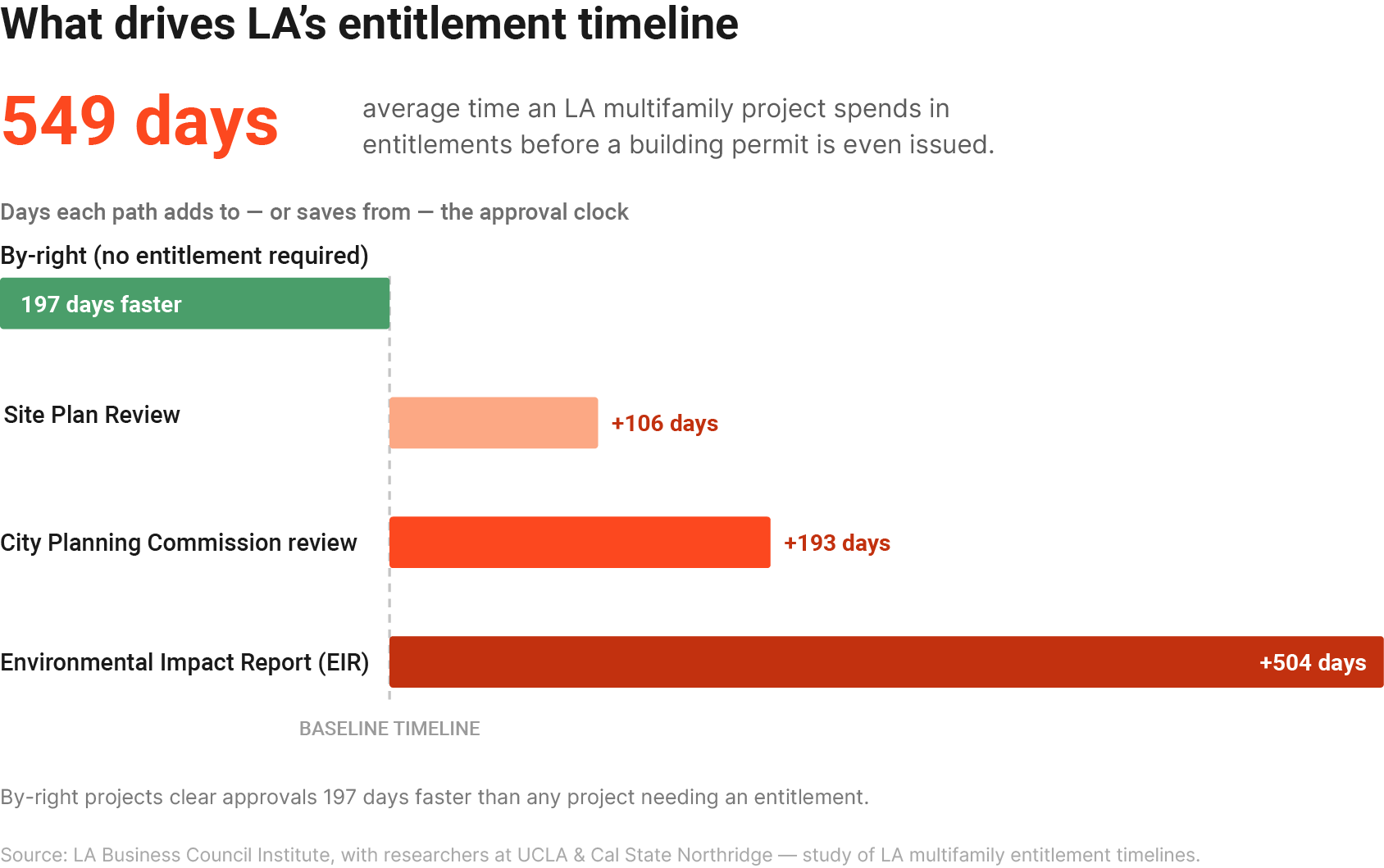
In Los Angeles, the average multifamily project spends 549 days waiting on entitlements before a building permit is even issued. That’s a year and a half of carrying costs, locked-up equity, and pro forma assumptions slowly going stale, before a single shovel touches dirt. The same study, conducted by the LA Business Council Institute with researchers at UCLA and Cal State Northridge, found that the average completed multifamily project takes 3.9 years from first application to occupancy, and the average completed unit takes nearly five years.
If you’re a developer, that number should make you uncomfortable. If you’re an architect partnering with developers, you’ve probably watched it happen in slow motion. And if you’re underwriting deals, you already know the punchline: most pro formas don’t price permitting risk anywhere close to its actual weight.
So let’s back up. What is permitting, why does it kill deals, and what’s the part everyone underestimates?
The short version: permitting is two things, not one
When people say “permitting,” they usually mean two distinct stages that get smashed together in conversation.
The first is entitlements. This is where a jurisdiction grants you the legal right to build what you’re proposing on a specific site. Entitlements cover zoning compliance, density approvals, conditional use permits, variances, environmental review, and any required public hearings. If you need a zone change, a height variance, or a determination under the California Environmental Quality Act (CEQA), that’s entitlements territory. This stage is discretionary, which means humans, commissioners, neighbors, and sometimes lawyers get to weigh in.
The second is building permits. This is the technical review of your construction documents against the building code, fire code, accessibility standards, and whatever else applies. Plan check, corrections, resubmittals, departmental clearances. This stage is largely ministerial, meaning if your drawings comply, you get the permit.
Entitlements get the headlines. Plan check eats the schedule. Most projects underestimate both.
Why permitting kills deals: it’s a math problem
Here’s the part that hurts. Every month a project sits in permitting, the carrying costs keep running.
According to analysis from REProforma, a $6 million floating-rate A&D loan at 8.5% accrues roughly $42,500 a month in interest, which means a six-month delay costs about $255,000 in extra interest alone. Scale that to a $40 million multifamily project and the math gets ugly fast.
But interest is the obvious line item. The real damage shows up in places pro formas rarely model:
- Land carry. Property taxes, insurance, security, and any short-term debt on the dirt keep accruing whether you’re building or waiting.
- Lost rent. A one-year delay on a 200-unit project priced at $2,400 per door per month works out to roughly $5.76 million in revenue that doesn’t get pushed forward, it disappears. The lease-up just starts a year later than your pro forma assumed.
- Rate exposure. If your rate lock expires or your construction-to-perm conversion falls outside the underwriting window, you’re repricing the entire capital stack at whatever the market gives you. Freddie Mac’s 2024 multifamily maturity risk analysis noted that loans originated in the low-rate period before 2022 face significant refinance pressure when they hit today’s environment, with the 10-year Treasury at roughly 4.0% versus a 2014-to-2018 average of 2.4%.
- Concession risk. Markets like Austin have posted twelve consecutive quarters of declining rents as supply caught up to demand, with landlords deploying four, eight, even twelve weeks of free rent to keep occupancy up. If you deliver into a softening market because permitting pushed your timing back, you’re absorbing concessions you didn’t underwrite.
- Late-stage delays compound. Research from small multifamily developer James Smithmeyer, cited in a 2026 KeyCrew analysis, points out that delays late in a project, when capital is fully deployed and tenants are lined up, do far more damage than delays early on. A three-month plan check correction at month 18 hurts worse than a three-month entitlement extension at month three.
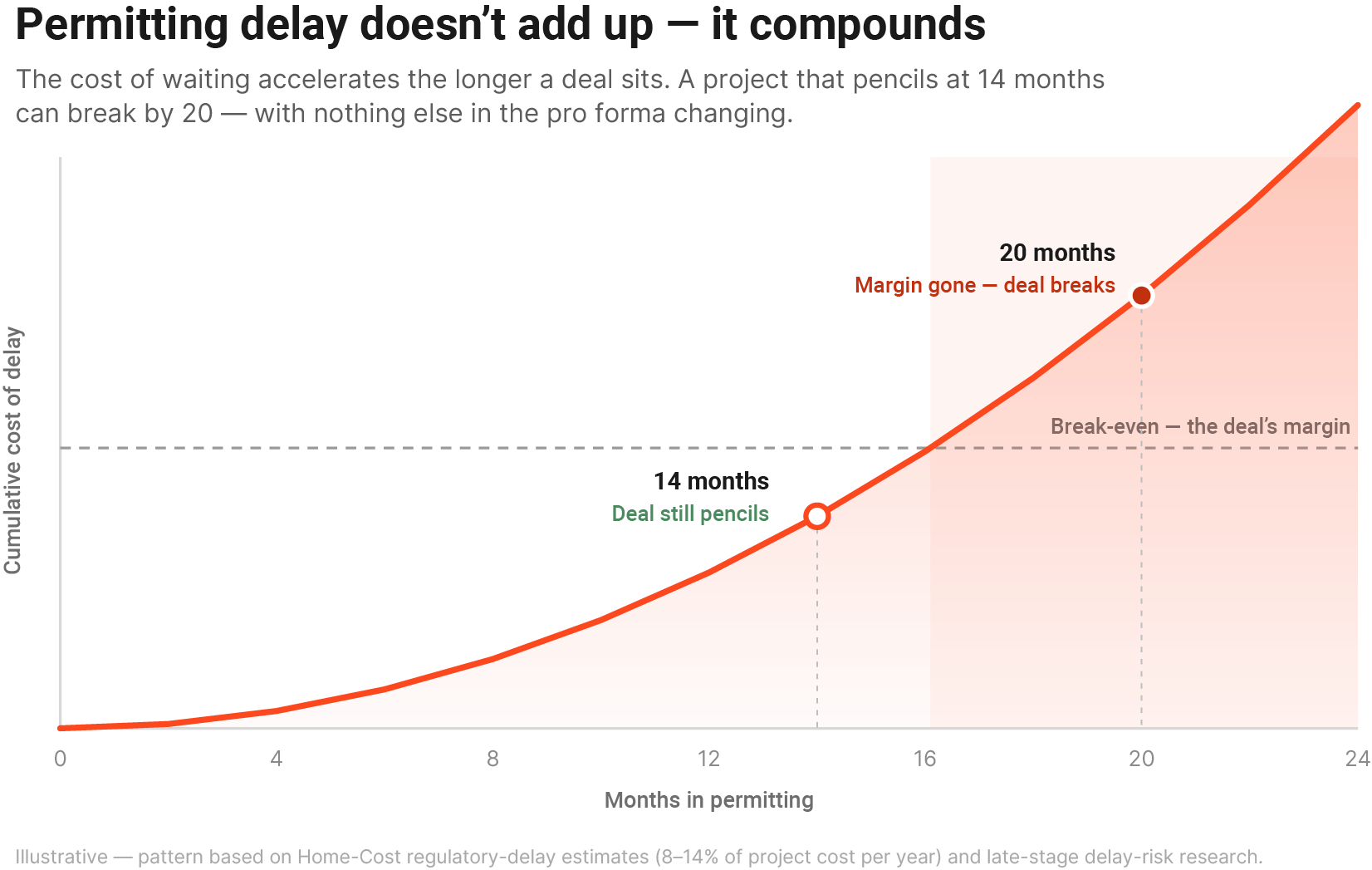
Industry estimates from Home-Cost put the cumulative cost of regulatory delays at 8 to 14 percent of total project cost per year of delay. The pattern across all of these is the same: time risk in permitting is non-linear. A deal that pencils at a 14-month timeline can fall apart at 20 months even with no other changes.
The LA case: where permitting math gets brutal
Los Angeles is the canonical example because the data is unusually well-documented and the dysfunction is unusually visible.
The LABCI/UCLA study found multifamily projects in the city averaged 549 days in entitlements and another 863 days in construction. The same research quantified what specific requirements add to the timeline: City Planning Commission review tacks on 193 days, Site Plan Review adds 106 days, and an Environmental Impact Report adds a staggering 504 days. By-right projects move through approvals 197 days faster than projects needing any entitlement at all.
The financial picture matches. As of December 31, 2025, CoStar reported that the city of LA had permitted just 81,306 of the 456,643 units it’s mandated to plan for by 2029, 17.8% of the goal with roughly half the timeline elapsed. As Cityview CEO Sean Burton told CoStar, “A lot of what’s been permitted is not financeable.”
The structural reasons are specific. CEQA reviews can be challenged by community groups even when projects qualify for categorical exemptions. Per LAist reporting in December 2025, neighbors can appeal an approved housing project for $229, while developers must pay $22,453 to appeal a denial. That asymmetry shapes how staff process every project.
LA isn’t unique in being slow, but it is unique in how predictably slow it is. According to Prevesta’s analysis of public permit records, NYC’s median permit approval time is 79 days, with 10% of permits exceeding 344 days. SF’s median is 209 days. Austin’s median is 22 days. The headline isn’t that some cities are faster than others. It’s that the variance within a single market can itself blow up a deal.
If you’re underwriting in LA and your pro forma assumes a 12-month entitlement timeline, pencil 18 to 24 months and stress-test from there.
The part everyone underestimates: feasibility decisions become permitting risk
Here’s what doesn’t get said enough: most permitting risk is locked in long before anyone files an application.
The decisions made during early feasibility, like density, massing, parking ratios, unit mix, FAR, setbacks, and which entitlement track you’ll pursue, are the decisions that determine how hard your permitting fight will be. By the time you submit, the most expensive variables are already fixed. The LABCI data backs this up: by-right projects clear approvals 197 days faster than projects needing any entitlement, and a project that needs an EIR adds nearly a year and a half to its approval window. Those outcomes are determined at feasibility, not at submission.
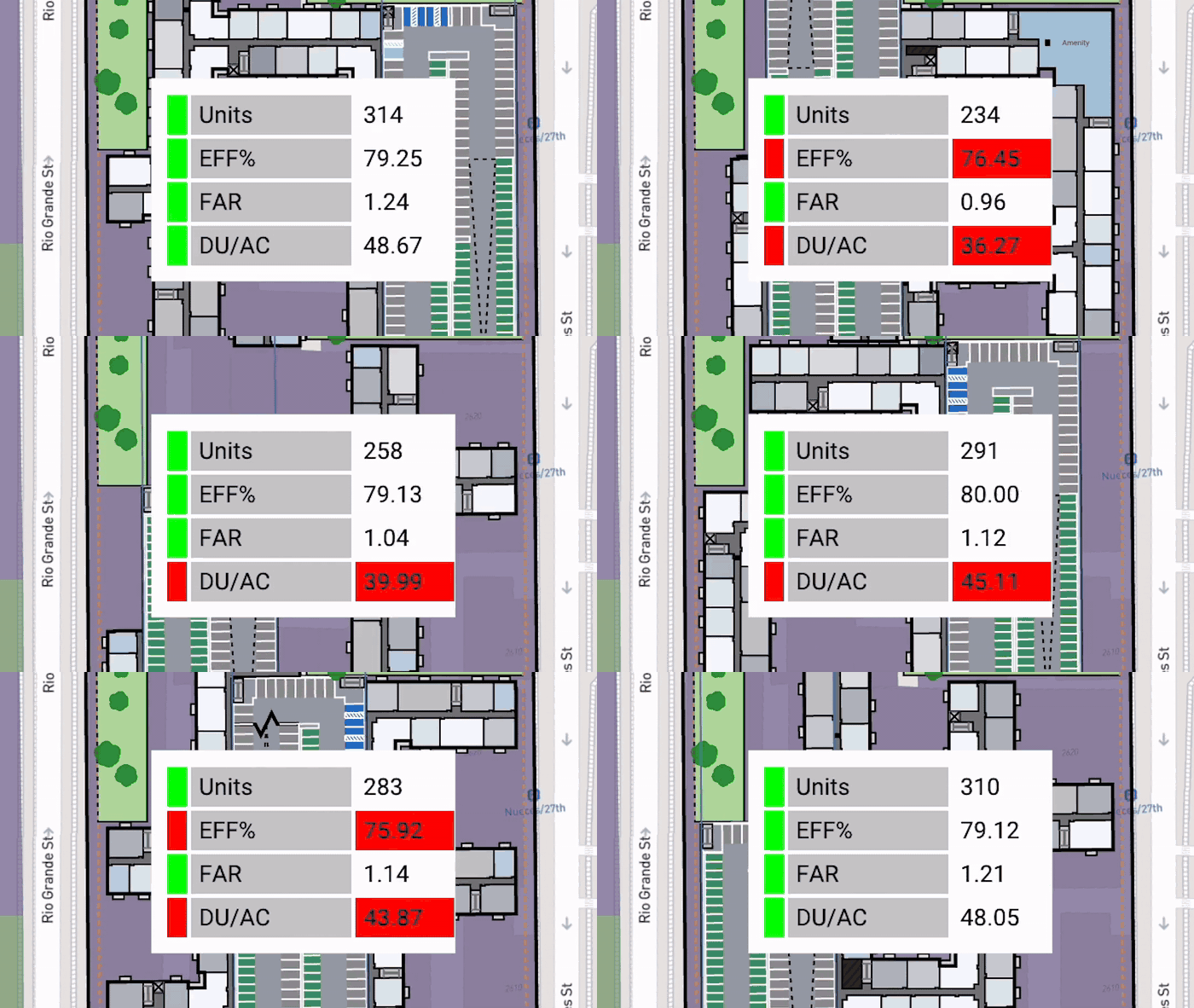
A developer who runs three or four serious massing options against a site’s zoning constraints during feasibility, who checks parking minimums, height envelopes, and likely CEQA exposure before going under contract, walks into the entitlement process with a project that fits. A developer who designs the unit count they want and then tries to entitle it walks into a fight.
This is the gap that early feasibility tools exist to close. When you can model massing, unit yield, parking, and conceptual cost in hours instead of weeks, you can pressure-test a site against its permitting reality before you commit capital. You can run the version that fits by-right, the version that needs a variance, and the version that’s going to need a community engagement strategy. You can price each one differently in your pro forma.
That’s where TestFit lives in the deal flow. The point isn’t to replace your entitlement counsel or your land use attorney. It’s to make sure the design you’re entitling is one that fits, and that you’ve priced the friction before the friction prices you.
The takeaway
Permitting is the part of development that looks like paperwork and behaves like financial risk. It compounds in ways most pro formas don’t model. It rewards developers who do their feasibility homework and punishes the ones who don’t. And in markets like LA, it’s increasingly the variable that decides which deals get built and which ones quietly die in plan check.
If you’re trying to make a site pencil, the question to ask isn’t just “what can I build here?” It’s “what can I build here, how long will it take to get approved, and what does that timeline cost me?” Answer that early, and permitting becomes a known risk you can price. Answer it late, and it becomes the reason your deal didn’t work.
Catch the deal-killers before they catch you.
Most permitting risk is locked in before you ever file — in the density, parking, and FAR calls you make at feasibility. Our free Site Analysis Checklist walks through what to pressure-test on a site before you go under contract, so the project you entitle is one that actually fits.