.svg)

Most people think a site plan is something you produce near the end of the planning process, like a drawing you review with the city or show to a lender. However, the best development teams treat it differently, and TestFit is built around that idea. For them, the site plan is a question: Can this site support the project I need it to be?
What Is a Site Plan vs. Other Floor Plans?
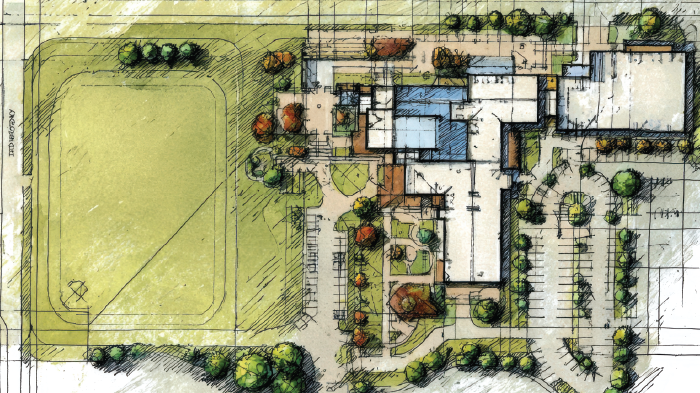
A site plan is a scaled, top-down view drawing showing how a building is proposed to sit on a parcel of land. It includes the parcel boundary, building footprint, setbacks, parking, site access, and open space.
It's one of several drawings that show up across a development project. A plot plan focuses on boundaries. A survey captures site conditions. A floor plan shows the actual layout. A site plan brings it all together.
At its core, it answers two questions: what can be built here, and does it work? Those questions matter from the first time a team looks at a parcel, not just when permits are being filed.

Why Feasibility Is the Right Time
The most expensive site planning mistakes happen when teams rush the early work. A parcel goes under contract, weeks of due diligence pass, and only then does someone discover the zoning doesn’t support the density, a flood zone cuts the buildable area, or the unit count needed to hit the pro forma doesn’t fit.
A site plan at the feasibility stage is a working model. It’s built to test viability before the deal pencils. At entitlements, where the team secures city approvals, permits, and zoning sign-off, it becomes a formal submission document. At construction docs, it’s a precise document drawn by a licensed engineer or architect. Each stage locks in more decisions. That's exactly why getting the feasibility stage right matters; it sets the foundation everything else builds on.
Earlier site planning means more options tested, constraints surfaced before they’re costly, and clearer conversations with sellers, partners, and lenders before capital is committed.

What a Feasibility-Driven Site Plan Covers
A strong feasibility site plan pulls zoning, site data, building form, and project numbers into one working model.
Zoning
Every site comes with rules, and building the wrong thing on the wrong parcel is an expensive mistake. Height limits, setbacks, FAR, and use restrictions loaded directly into the model mean the plan reflects what the code actually allows from the start, not after a costly revision.
Site Analysis
The biggest risks on a site are often the ones you didn't know to look for. Our site analysis checklist is a good place to start. Overlaying topography, FEMA flood zones, wetlands, soils, major utilities, and parcel data surfaces those constraints early, before irregular property lines, hidden easements, or tricky grading turn into due diligence surprises or deal-killers.
Massing & Typology Options
Committing to one building form too early is one of the most common ways feasibility studies leave value on the table. Iterating different typologies and configurations on the same parcel in the same session makes it easy to see how density, footprint, and efficiencies shift across options before any direction is locked in.

Tabulations & Deal Modeling
A site plan without numbers is just a drawing. Unit counts, gross square footage, efficiency ratios, and parking ratios generated alongside the plan keep the project math connected to the model. When the form changes, the numbers change with it. That connection runs deeper than basic counts. Revenue, expenses, and NOI update in real time alongside hard costs, soft costs, and land costs, so the full cost picture moves with the design.Yield on cost and cap rate tie projected returns directly to the configuration being tested, making it possible to compare not just which typology fits the site, but which one produces the better deal. Every design decision becomes a financial one.
Optimal Parking
Parking is one of the most consequential decisions made during feasibility, and one of the easiest to get wrong. The number of stalls, the layout, and whether parking is structured, podium, or surface all have a direct impact on unit count, buildable area, and project cost. Getting the parking configuration right at the feasibility stage means the rest of the site plan has an accurate foundation to build from. Optimize it too late and the ripple effects touch everything, from the pro forma to the floor plate.
Watch our webinar on maximizing parking efficiency to see how generative design handles this in practice.

Who Creates the Site Plan?
Site plans don't come from a single source. Who builds one depends on where you are in the process and what decision needs to be made.
Developers and acquisitions teams are often the first to produce a feasibility-stage site plan. Their goal is speed. Before a parcel goes under contract, they need to know whether the site can hit the unit count, FAR, and yield on cost required to make the deal pencil. At this stage, the site plan is less about design and more about financial validation.
Architects take on the site plan as the project matures from feasibility into design. They bring building form, circulation, open space, and aesthetics into the picture, coordinating across consultants and clients to move the project from viable to buildable. The site plan becomes a design document, not just a test.
Civil engineers produce the most technical version. At the construction documents stage, they are responsible for grading, drainage, utilities, road layouts, and regulatory compliance. Their drawings carry the legal and engineering weight required for permitting, and their involvement often catches site constraints, from tricky topography to stormwater requirements, that earlier plans didn't fully account for.
Brand and corporate real estate teams use site plans differently than traditional developers. Rather than testing a range of typologies, they are validating whether a fixed prototype, a specific store footprint, parking count, drive-through configuration, or access requirement, fits a given parcel. For them, the site plan is a pass/fail instrument that determines whether a site moves forward or gets cut before any capital is committed.
Site Plan Requirements by Use Case
Every development type brings its own site planning priorities. While the fundamentals stay the same, what gets scrutinized, optimized, and validated shifts based on the product type.
Multifamily
- Unit count and density relative to FAR and zoning limits
- Parking ratio and configuration, structured, podium, or surface
- Setbacks, open space minimums, and amenity areas
- Efficiency ratio between gross and net rentable area
Subdivision
- Lot count, lot dimensions, and road layout
- Utility stub-outs, easements, and right-of-way dedication
- Grading and stormwater management across the full parcel
- Phasing plan and infrastructure sequencing
Retail
- Prototype fit, fixed store footprint, drive-through stacking, and access points
- Parking count and layout relative to local code and brand standards
- Visibility and ingress/egress from major roads
- Pad orientation and outparcel potential
Industrial
- Truck court depth, turning radii, and dock door count
- Clear height requirements and bay dimensions
- Trailer storage, employee parking, and circulation separation
- Impervious coverage and stormwater management
The Cost of a Site Plan
Site plan costs vary widely depending on who produces it, when it gets made, and how many revision cycles it takes to get to an answer.
The traditional way means waiting and juggling.
A developer identifies a site, engages an architect or civil engineer, and waits days or weeks for a feasibility study to come back. In the meantime, the team is spread across multiple tools: Excel for financial modeling, CAD for 2D site output, a separate 3D modeling platform for massing, and a presentation tool like Adobe InDesign or PowerPoint to pull it all together for stakeholders.
Each revision, a zoning change, a parking adjustment, a typology swap, means updating all of them. Architect feasibility studies can range from a few thousand dollars for a simple site to tens of thousands for complex programs, and that cost multiplies with every iteration.
By the time the site plan reflects reality, significant time and money have already been spent, sometimes on a site that doesn't pencil.
The TestFit way consolidates that entire stack into one environment.
Zoning, massing, parking, financial modeling, and presentation-ready outputs all live in the same place and update together in real time. A working site plan can be generated in hours rather than days, and revision cycles that used to span weeks happen in a single session.
In the design sessions, we can get to a massing or a yield that’s probably within 10 to 15% margin of error, oftentimes in 30 minutes or an hour. That usually takes weeks with a traditional design process.
— Michael Bernstein, Development Manager at The Geyser Group
Teams can evaluate more sites in less time, test more configurations before committing to a direction, and arrive at due diligence with a clearer picture of what the land can support. The cost of getting it wrong drops significantly when the answers come earlier.
The pattern is consistent across every stage and every team: the earlier the site planning work happens, the less expensive the corrections are.

The Site Plan Is Where the Deal Gets Made
Built after the design is set, a site plan records decisions already made. Built early, it makes better ones possible.
TestFit puts zoning, data, massing, and financials into a single environment so teams can run that analysis at feasibility, across more scenarios, before capital is on the line.
The best deals pencil early. See what that looks like on your next site.
Request a demo at testfit.io